Winter 2026

Pharma of the Future

Jonathan Rivnay is creating implantable devices that produce medications from within the body. By Carolyn Wilke

All illustrations and graphics by Daniel Hertzberg

Every day, people reach for medications to control blood pressure, manage fertility or help them fall asleep. Many inject themselves with pharmaceuticals to manage pain or control food cravings, and some regularly visit clinics to receive infusions to treat cancer or autoimmune condition.

But failure to take medications as directed has dire consequences. An estimated 125,000 people in the U.S. die each year due to nonadherence to prescribed treatment, which also results in roughly $100 billion annually in preventable health care costs.  

Northwestern professor Jonathan Rivnay is working toward a solution. He and colleagues at the University and partner institutions have created an implantable pharmaceutical factory that “lives” inside a person’s body. Unlike most existing biomedical implants, this one teems with life — full of cells engineered to manufacture drugs that treat disease or provide cues to help the body heal. With these living pharmacies — biohybrid devices that combine synthetic biology with bioelectronics — Rivnay hopes to regulate the production of drugs inside a patient and ultimately improve health outcomes.  

Controlled-release implants and skin patches loaded with medicines already exist. But most commercial products don’t allow for dynamic control of dosing, says Rivnay, the Jerome B. Cohen Professor in Engineering. By comparison, the new implant is engineered for remote control, allowing doses to be tailored to the individual and adjusted over time.  

Cells are masterful molecule makers that can precisely manufacture compounds, such as hormones and enzymes. And synthetic biology — the practice of engineering a cell’s genetic material to create new functions or modify existing ones — has made it increasingly possible to reprogram human cells to produce those compounds. Meanwhile, advances in bioelectronics have made it feasible to exercise electrical control over physiological function. By combining biology, electronics and materials engineering, Rivnay and his team are building devices to manage the complexity of a living cellular system while simplifying the production and delivery of medications. 

“It could be a whole new paradigm in how we deliver medicine in a personalized manner,” says Rivnay, a faculty member in biomedical engineering, materials science and engineering in the McCormick School of Engineering 

Rivnay and his colleagues have designed several biohybrid devices — ranging in dimension from a square gadget the size of a smartwatch face to a lip balm–sized tube — to deliver therapies for cancer, diabetes and obesity. And they’ve engineered a prototype that dispenses hormones to control the body’s sleep-wake cycle. Creating these wireless, living, cell-based implants requires an array of expertise. As it happens, Rivnay is an expert not only in bioelectronics but also in building teams to tackle lofty goals. 

An illustration of a pharmacist with long hair who is facing away from the viewer against a blue patterned background. The pharmacist is selecting a pill bottle from a set of shelves that is shaped like the silhouette of a man. To the left of the pharmacist is another silhouette cut-out of a woman with shelves of pill bottles inside her as well.

Rivnay’s enthusiasm for materials research began during his undergrad days at Cornell University, where he majored in materials science and engineering and worked with materials scientist George Malliaras to make organic light-emitting diodes (OLEDs). Today we take OLED displays on smartphones for granted, Rivnay says. But in the early 2000s, this research exposed him to a rapidly expanding field.  

While in graduate school at Stanford University, Rivnay studied semiconducting polymers; these materials were initially used in solar cells and quickly gained traction for biological applications, he says. In addition to mimicking the soft, squishy feel of body tissues, these materials can also conduct electricity, not only with electrons hopping along the polymer chains but also with the movement of ions. They’re “speaking the same language as biology,” Rivnay says.  

In 2012 Rivnay reunited with Malliaras, this time in the department of bioelectronics at the École Nationale Supérieure des Mines de Saint-Étienne in France, and joined a wave of researchers who were using organic electronics for biological applications. As a postdoctoral fellow, Rivnay worked on devices that can map the brain’s responses to events by amplifying subtle signals from firing neurons. He also developed devices to stimulate the brain, which could potentially help treat diseases such as epilepsy that are caused by surges of electrical activity in the brain. It was his first experience on a team of biologists and engineers working side by side.  

Rivnay landed at Northwestern in 2017 and has since built a team of 20 that includes research assistant professors, grad students, undergrads, postdocs and a research technician. His work has connected him to experts in other fields across the University too.

“Collaboration across domains, working with clinicians, being able to build teams for larger projects — that’s in the DNA of Northwestern,” he says.

 Jonathan Rivnay is wearing glasses and a light blue collared shirt and dark blue blazer. He holds his biohybrid device in front of a magnifying glass. The device is about the size of a tube of lip balm.
Rivnay holds his team’s first-of-its-kind biohybrid device, which is being developed to treat ovarian cancer. IMAGE: SHANE COLLINS
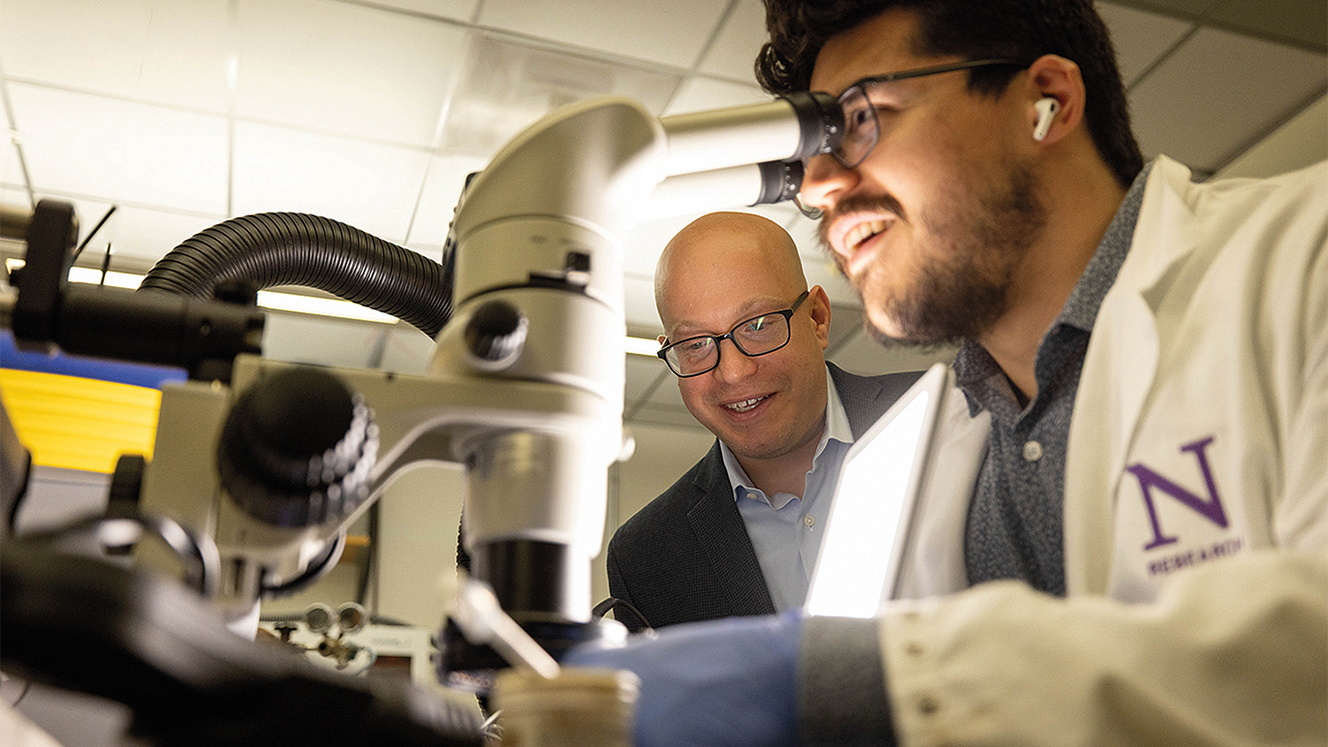
Juan Villacres Perez wears a lab coat and looks into a microscope while Jonathan Rivnay watches on in the background.
Jonathan Rivnay observes as Northwestern researcher Juan Villacres Perez inspects electronics for a biohybrid device. IMAGE: SHANE COLLINS
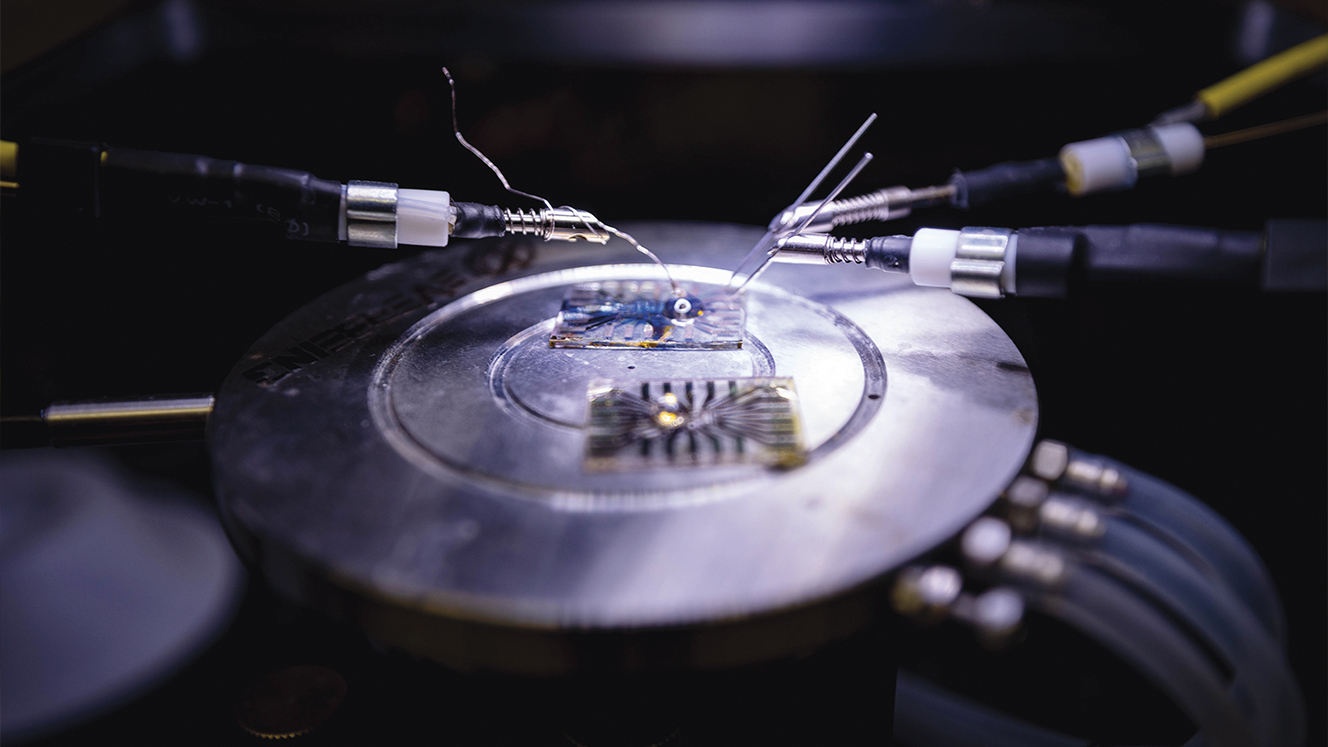
 Small electronics lie flat on a metal disk while two robotic arms poke at them with metal pieces.
A testing rig in Rivnay's lab measures the performance and function of sensors and transistors in bioelectronic devices. IMAGE: SHANE COLLINS

In April 2020, when schools and businesses went remote, Rivnay holed up in his bedroom’s walk-in closet for Zoom calls with collaborators. His two sons — 1 and 4 at the time — would frequently knock on the door, looking for a playmate. Rivnay and his sons spent their evenings “doing art” — the boys painting with watercolors while Rivnay sketched out ideas for a device.

He and his colleagues had seen a call for proposals from the Defense Advanced Research Projects Agency (DARPA) for a means to help the body adjust its internal clock to a new time zone. This could be useful for traveling military personnel or shift workers adjusting to a night schedule. With no in-person meetings or lab work to draw them away, Rivnay and other researchers got to thinking about a solution. 

The team hypothesized that using a type of cell therapy — in which engineered human cells are placed in the body to treat disease — could produce chemicals that control circadian rhythms. It’s a method that’s been effective in treating other conditions. One currently available cell therapy, for example, uses modified blood cells to treat sickle cell anemia. Others use immune cells to treat cancer. These cell therapies require extracting a patient’s cells, modifying them and infusing them back into the body. Others, such as a newly approved cell therapy for macular degeneration, rely on implants of exogenous cells — that is, cells not from that patient.

But it can be a challenge to keep implanted cells alive. Without access to oxygen from blood vessels, cells can quickly die. Rivnay’s team tackled this problem in 2023 when, alongside collaborators from Carnegie Mellon University (CMU), they succeeded in producing oxygen near the cells by using electricity to split water molecules. They then created an oxygenator-equipped device that could keep around 80% of the cells packed into a chamber alive for four weeks. By outfitting their devices with an oxygenator, they found that cells stayed alive at very high densities — more than tenfold what they saw in typical cell therapies, Rivnay says. 

A later proof-of-concept device delivered leptin, a molecule that’s associated with hunger and plays a role in regulating certain circadian rhythms. Rivnay and colleagues continue to work on this project while applying what they’ve learned to new initiatives to treat ovarian cancer, diabetes and obesity. A more recent oxygenator prototype kept cells alive for more than two months. 

To control the cells’ activity — how and when they produce molecules — the team tapped synthetic biologists at Northwestern and other universities. Synthetic biology co-opts natural life processes for other useful purposes. Applying synthetic biology “to mammalian cells went from hypothetical to sort of everyday in the past five years,” says  Joshua Leonard, a Northwestern professor of chemical and biological engineering and one of Rivnay’s collaborators. Leonard’s group came up with some of the field’s key techniques and approaches for engineering mammalian cells, including human cells. Synthetic biology enables researchers to improve upon traditional cell therapy, specifically by allowing them to control the dosing on an ongoing basis.


Rivnay’s collaborators at Rice University have engineered human cells that respond to external cues, such as light from an LED. Rivnay’s team has incorporated this discovery into the living pharmacy device. The light cues the cells to initiate drug production, and the light’s intensity or duration relays the message of how much of the drug to make. Powering lights, however, means including a battery that takes up half the device’s volume. So the team, with input from Leonard’s lab, instead used electrical signals to activate the cells.  

Shrinking the device to take up less space in the body is another priority for the researchers. In October 2024 Rivnay teamed up with collaborators on a $34 million award from the Advanced Research Projects Agency for Health to develop a minimally invasive pharmaceutical implant that dispenses treatments for diabetes and obesity. The researchers aim to make their device pill-sized, a few millimeters in diameter, and hope to implement wireless power transfer.  

Guillermo Ameer, the Daniel Hale Williams Professor of Biomedical Engineering at McCormick and professor of surgery in the Feinberg School of Medicine, says Rivnay’s technology is “visionary.” A method to program cells, activate them and protect them while they’re in the body could be useful far beyond administering drugs. Ameer, one of Rivnay’s collaborators, says such devices may help the body restore tissues or prevent their deterioration.

Some ligament tears, for example, are treated by attaching tissue taken from elsewhere in the body, “which is destroying one part of your body to try to fix the other part,” says Ameer, director of the Querrey Simpson Institute for Regenerative Engineering. A regenerative engineering approach would instead seek to grow new tissue. A surgeon could implant scaffold materials — on which to grow new tissue — along with a biohybrid device that dispenses molecules that spur tissue growth and prevent the development of scar tissue, he says. Ameer, Rivnay and their colleagues recently secured a $4.7 million grant to develop a device to monitor wounds, quicken their healing and lower infection risk. 

Rivnay’s goal is for biohybrid implants to make it to the clinic. He and colleagues are engaging with the U.S. Food and Drug Administration (FDA) for feedback regarding a clinical trial of their implant to treat ovarian cancer. The device produces an FDA-approved treatment that is usually given through infusions. The researchers recently tested it in a large animal model. The device produced the biologic drug for more than 60 days.  

“This is our first effort to not only translate some of this technology [to practical application] but also move this toward helping treat patients,” Rivnay says. “We have a huge opportunity with these biohybrids. These types of products just don’t exist.”


Carolyn Wilke ’18 PhD is a Chicago-based freelance science writer and editor. She is an adjunct lecturer in the Medill School of Journalism, Media, Integrated Marketing Communications. 

Share this Northwestern story with your friends via...

Reader Responses

No one has commented on this page yet.

Submit a Response