
Inspirational Directions
Meet the 2022 recipients of the NAA’s highest honor, the Northwestern Alumni Medal: ‘Sex and the City’ writer Cindy Chupack ’87, broadcasting veteran David Louie ’72 and Inclusive Capital Partners founder Jeff Ubben ’87 MBA.
Richard Kind ’78 leaned into his playful everyman persona at Northwestern. By Brenna Ehrlich Enos
Richard Kind is cruising to his summer spot on the Jersey Shore in his ancient Honda Odyssey when he interrupts our phone interview to make a very important call.
He calls back a few minutes later. “Want to know why I had to get off the phone?” he asks in his distinctive voice — perpetually stressed out with a dash of barely suppressed mirth. “Because I have E-ZPass.”
Kind ’78 had driven through a tollbooth and received an urgent message to call the service center — and suddenly we’ve launched into what could be a bit from Curb Your Enthusiasm, a comedy series in which Kind played creator Larry David’s loudmouthed and socially oblivious cousin Andy for nearly two decades.
To be clear, Kind isn’t the type of actor to hire someone to manage the minutiae of everyday life — such as keeping one’s E-ZPass account in good standing. He’s also not the type of actor to hire a driver … or even drive a new(er) car. His Honda Odyssey is pocked with dings and bumps that resemble “a 15-year-old pubescent’s face,” he says. “It will never get stolen because nobody wants this car.”
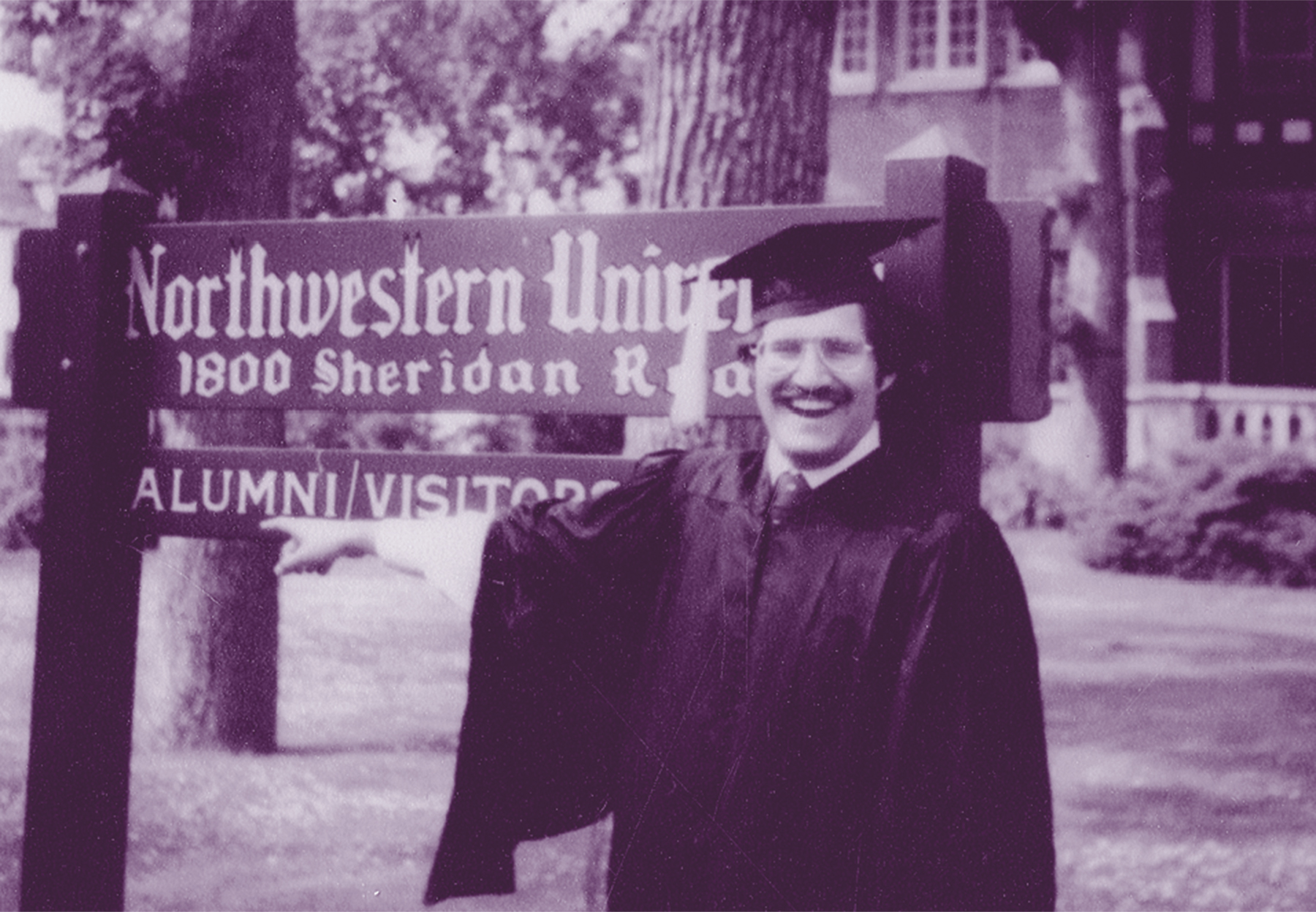
Maybe that’s all because he wasn’t supposed to be an actor at all. Ever since Kind was a baby in Bucks County, Pa. — a baby who looked remarkably like his future 69-year-old self — his path was laid out for him: “I was supposed to go to law school and business school” and then straight into the family business, he says. “I went to Northwestern to take over the jewelry store [LaVake Jewelers in Princeton, N.J.] from my dad.”
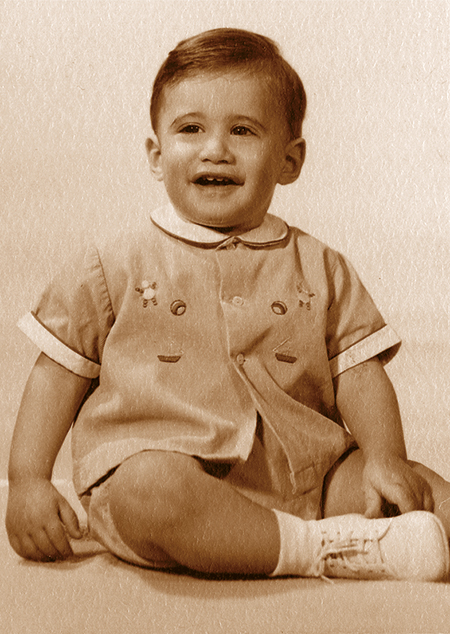
Baby Kind. Credit: Courtesy of University Archives
But Kind secretly dreamed of being an actor, and his tenure as a Northwestern student upended the family business succession plan. With support from professors who recognized his talent for acting and wouldn’t let him give up on his dreams, Kind strayed from his predetermined post behind the jewelry counter, landing instead in the entertainment industry.
“Theater was not something you did,” Kind says, recalling his upbringing. “You could dream about it, but you didn’t actually do it. You had a regular life. … I was always a good kid, but my biggest rebellion was not working at my dad’s store.”
Kind is definitely “that guy” — the hilarious, easily recognizable, rubber-faced actor who pops up on your favorite sitcom or movie, often playing brash and unorthodox characters. He was the overly dramatic doctor Mark Devanow on Mad About You, the eye-patch–wearing Vince Fish in Only Murders in the Building and the unwelcome houseguest Arthur Gopnik in the Coen brothers film A Serious Man. He starred as American architect Addison Mizner in the Stephen Sondheim musical Bounce (now called Road Show) and voiced Bing Bong in Pixar Animation Studios’ classic Inside Out. His extensive list of acting and voiceover credits on IMDb includes varied and wide-ranging roles.
Despite his quirky vibe, however, Kind is also an everyman — a persona he perhaps developed at Northwestern, where the social butterfly mixed and mingled with everyone from theater kids to frat boys. On screen or stage today, it seems easy for him to slide into any character’s skin, imbuing each role with a deep level of humanity that can’t be taught, even by the best acting coach.
At Northwestern he studied everything — and, more importantly, everyone. He recalls walking back to Shepard Hall, his first-year dorm, after class: “I would stop at every person’s room just to chitchat and check in. It took me 40 minutes to get to my room, and then we would stay up at night and talk.
“College is not just about academic learning,” he adds. “It’s about taking off your blinders and seeing the whole world of people who come from different places. It’s not just about the books. In college, you learn how to learn about people.”
In a letter to his grandmother — written with immaculate penmanship — Kind gushed about a class on UFOs and groused about the dining hall food.
He recalls wandering the tree-lined paths and absorbing knowledge from his communication studies classes with the same level of curiosity that he brought to his friendships. “I just loved being at Northwestern,” Kind says. “I loved school. I loved learning. I loved my friends. I loved parties.”
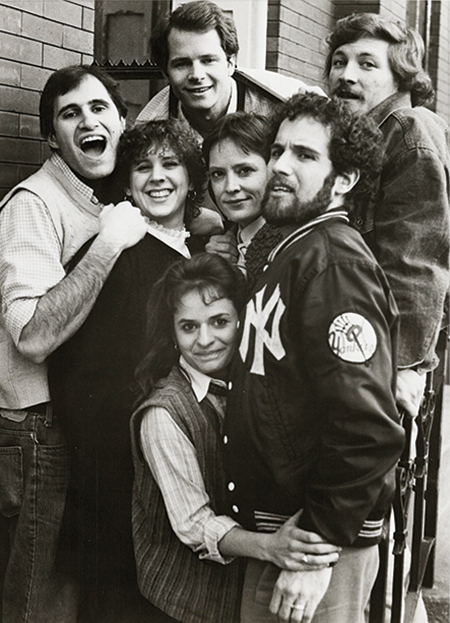
After acting in New York City for four years, Richard Kind returned to Chicago in the early 1980s to join the Practical Theatre Company, a group founded by Northwestern students. Credit: Courtesy of University Archives
His study of human behavior — both in and out of the classroom — paid off. As a first year, he scored a prized role in an off-campus University Theatre production of the 1966 musical The Apple Tree (with lyrics by the late Sheldon Harnick ’49, ’18 H). The following year, he played the villainous Thomas Danforth in the University Theatre production of Arthur Miller’s The Crucible at Cahn Auditorium. (Kind also performed in Waa-Mu, though he’s still “disgruntled” he was never cast in The Mee-Ow Show.)
“I think he has this great quality — the understanding of what it’s like to be a normal person, the frustrations of it,” says Irving Rein, one of Kind’s favorite instructors. “I think Northwestern was really important in that.”
Kind raves about his School of Communication professors, including Rein, David Zarefsky ’68, ’69 MA/MS, ’74 PhD and the late Frank Galati ’65, ’67 MA/MS, ’71 PhD, who encouraged him to pursue an acting career. (His Sigma Alpha Epsilon fraternity brothers, meanwhile, kept him grounded, dishing out healthy doses of humble pie.)
But when Kind expressed doubts about his future as an actor, the director of The Crucible “sat me on the stage and berated me that I was quitting the theater,” Kind says.
Galati also pressed him to take the plunge. “He said, ‘Go try it. Maybe you’ll be successful. Maybe you won’t,’” Kind recalls. And in a prescient moment, Galati told him, “‘You’re not a leading man, but when you’re about 33 or 34, you’re going to come into your own.’”
Importantly, Galati taught Kind to go all in.
During one oral interpretation course, a classmate performed a scene from A Streetcar Named Desire. “She was very mousy,” Kind says. “And Frank tells her, ‘Listen. Your parents are paying a lot of money to let you act. We’re giving you a chance to not only do what you want to do but what you believe God put you on this earth to do. So give it to us!’
“That’s when I learned to like auditioning,” Kind adds, “because you go into a room and you get to do what you do best — not to get a job, not to impress these people — to get a chance to act. So, give it your all!”
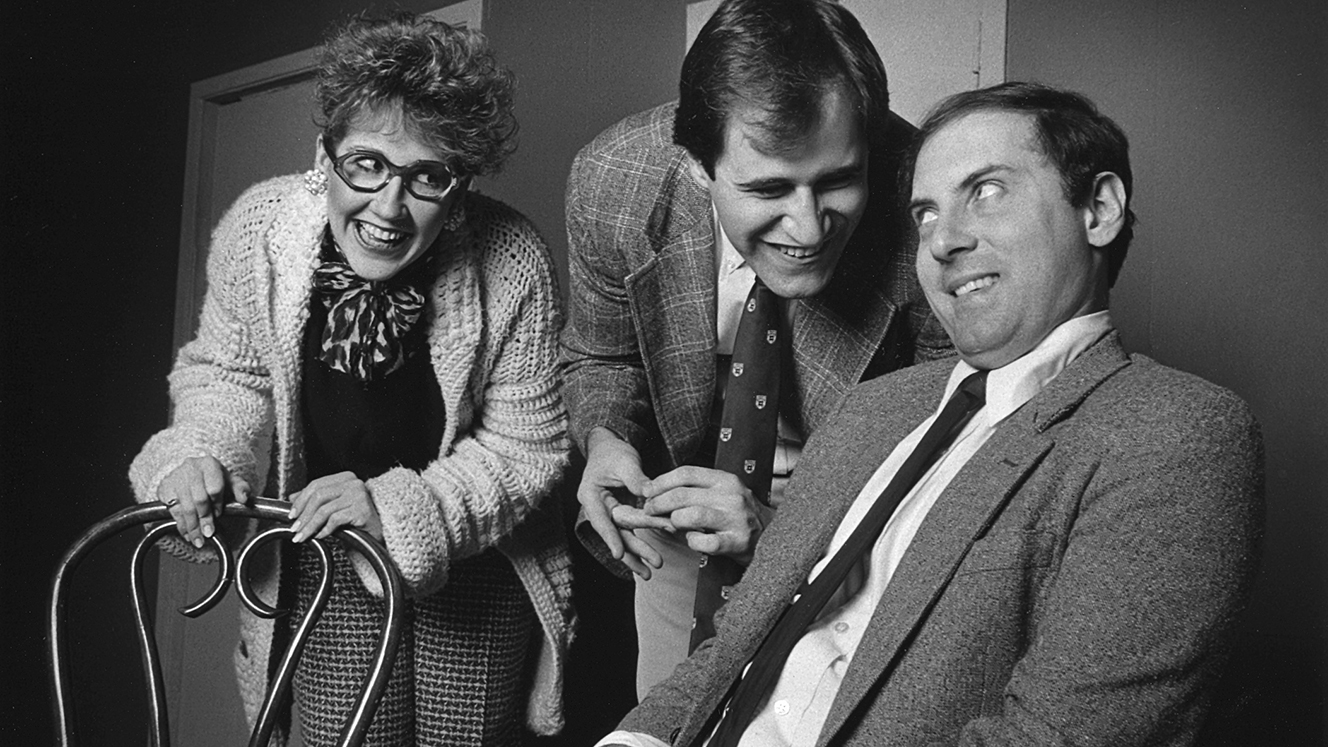
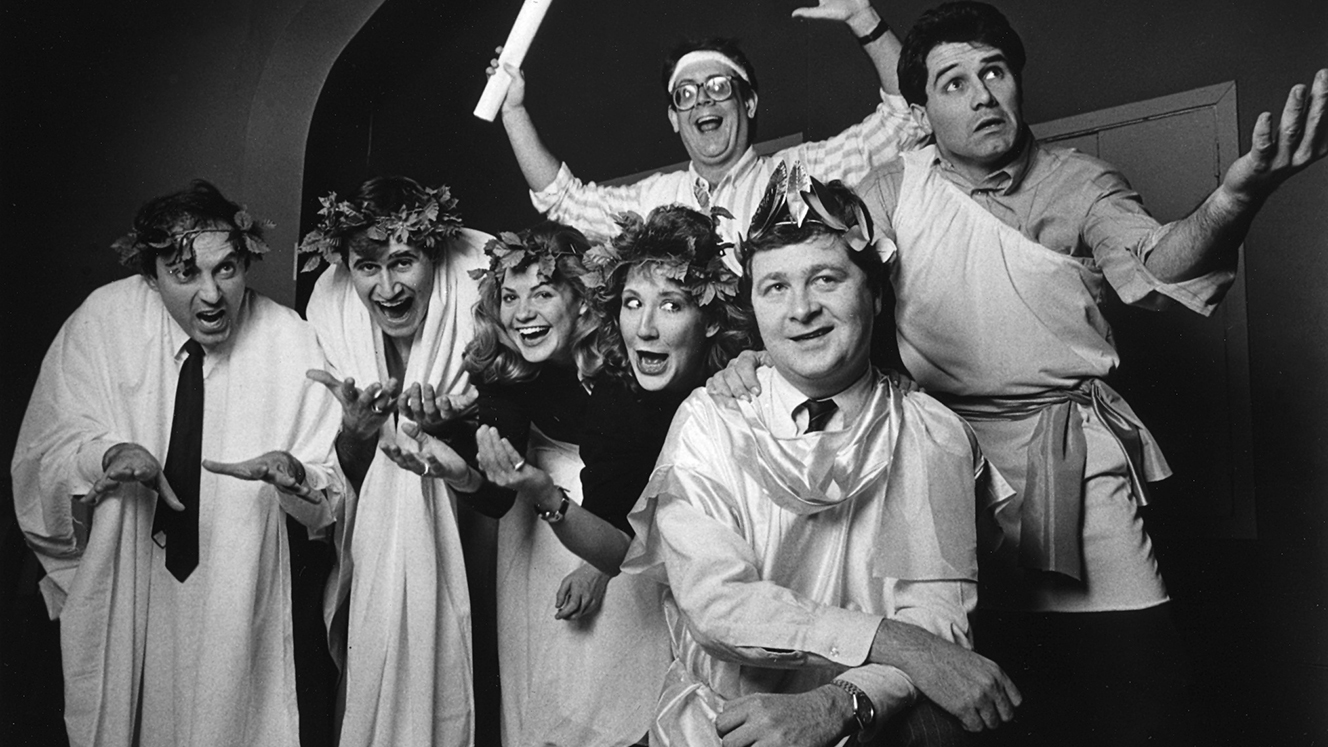
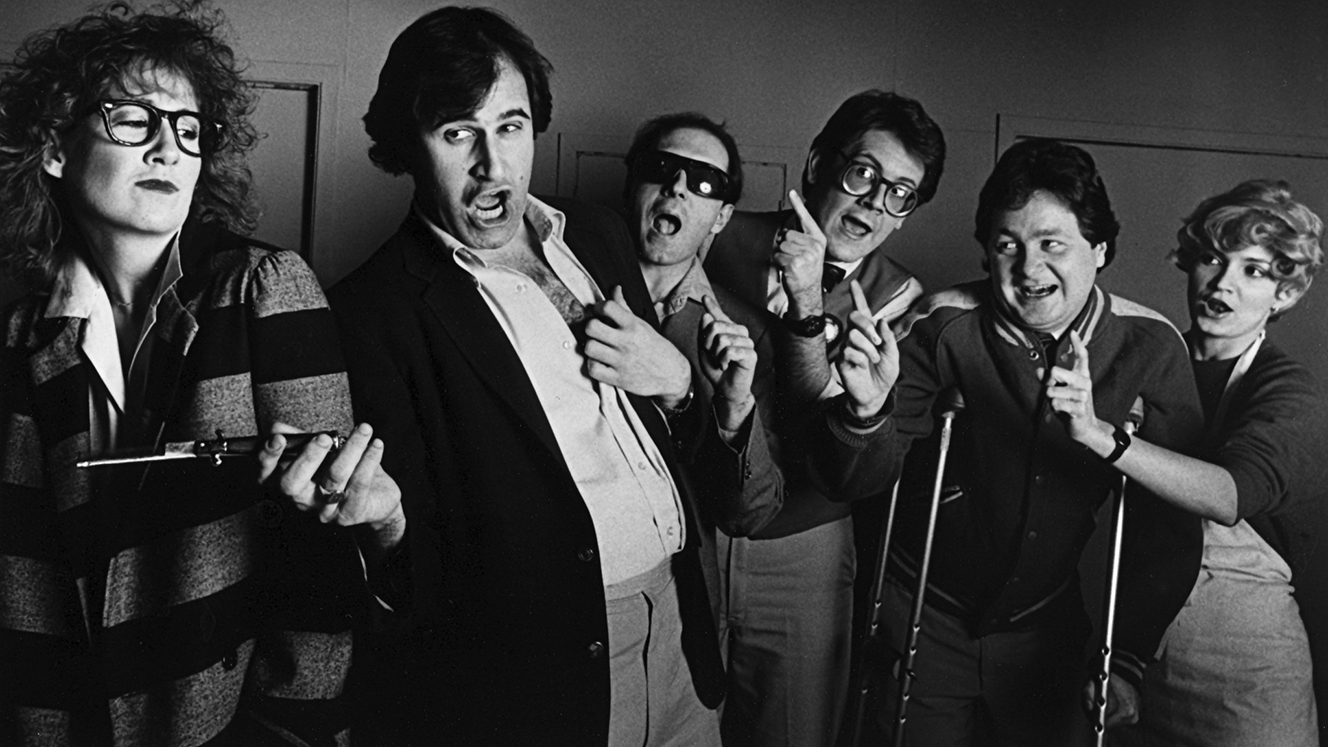
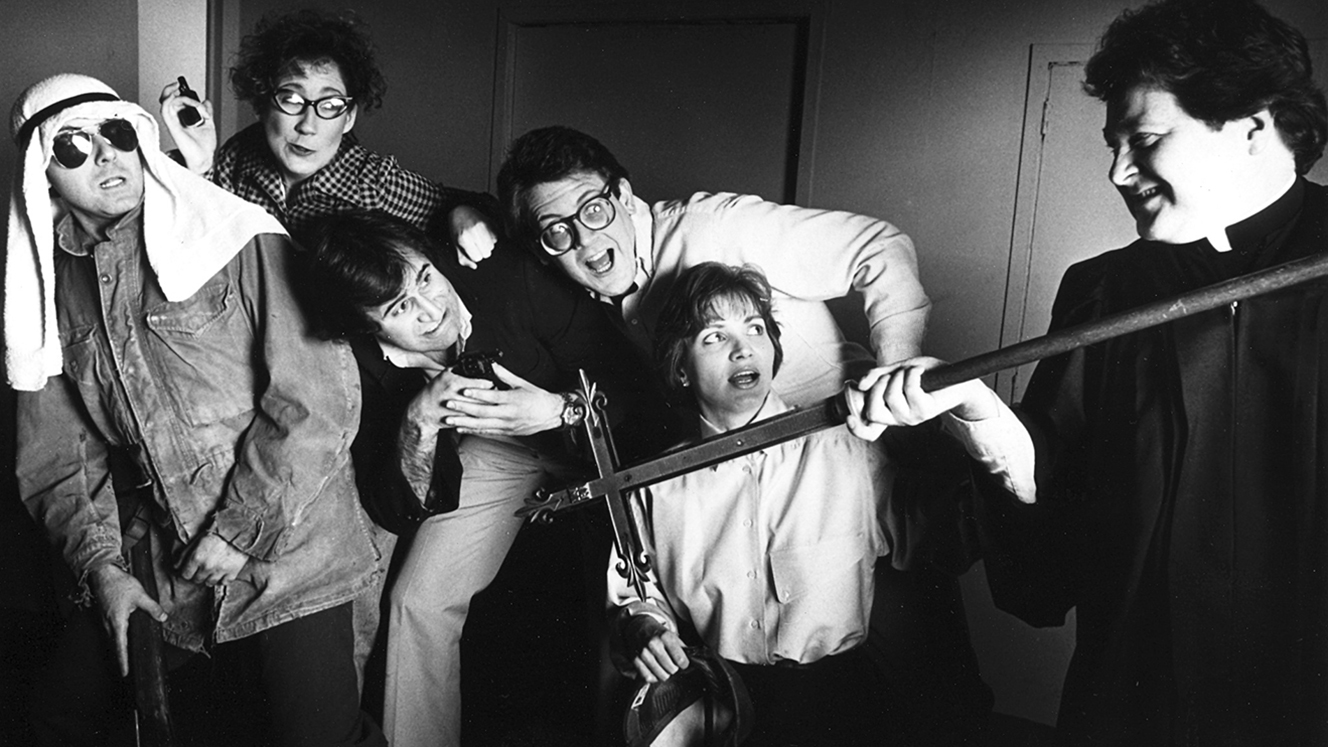
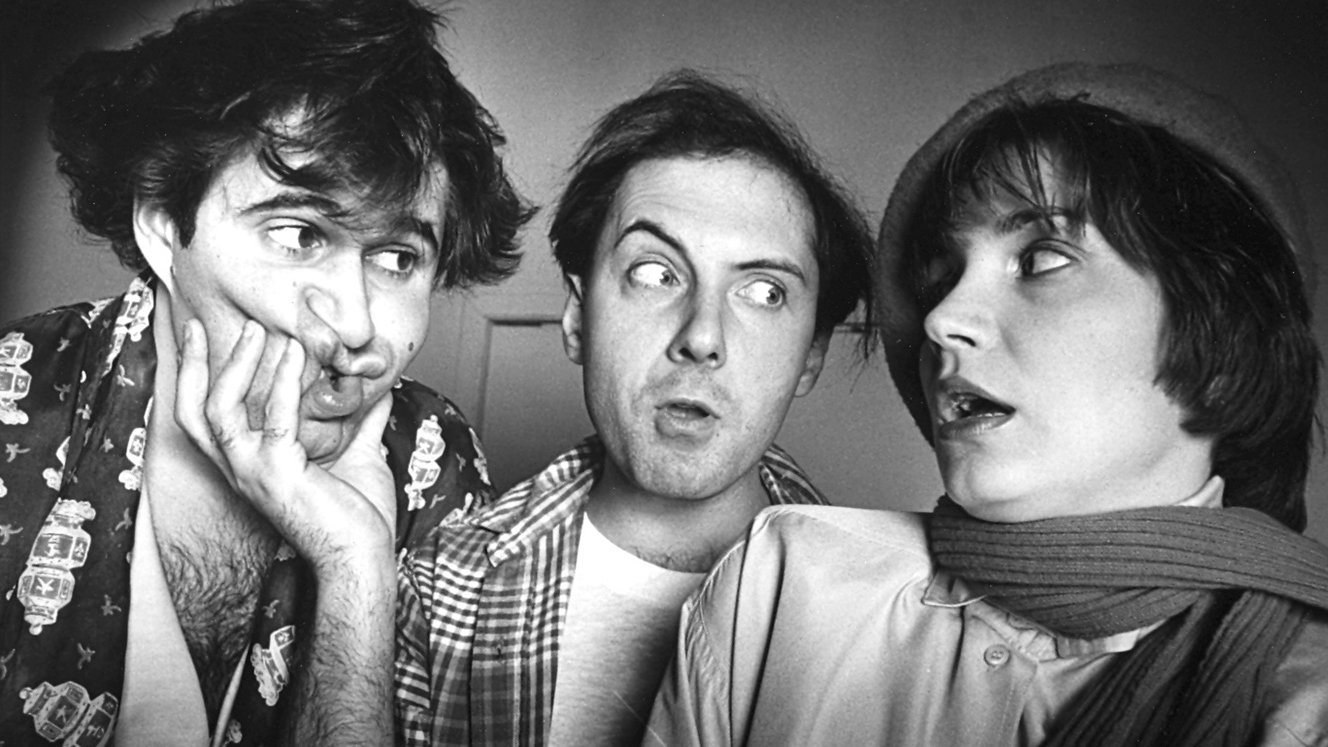
After college, Kind’s career unfolded much as Galati foretold: Kind moved to New York City for four years, appearing in “off-off-Broadway shows” and getting his Actors’ Equity Association card. Then it was back to Chicago, where he joined Paul Barrosse ’80, Brad Hall ’80, Gary Kroeger ’81 and Julia Louis-Dreyfus ’83, ’07 H doing comedy revues as part of the Practical Theatre Company. The 1983 production Mega Fun caught the eye of Second City co-founder Bernard Sahlins, who recruited Kind for the main stage — despite Kind’s lack of improv experience.
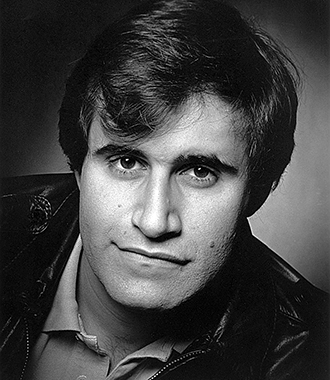
Richard Kind’s Second City headshot from 1983. Credit: The Second City
“People call Second City the Harvard of comedy, but it’s really a great acting school, because you are onstage every single night,” Kind says. “I was smarter there because I had to be up to date on the news of the day. I had to be at my most literate.”
For 4½ years, Kind honed his comedy and improv chops on that legendary stage, playing everything from a snooty waiter to an irate prospective father-in-law. He also did summer stints in Atlantic City, N.J., where the Second City cast put on 12 shows per week in between crashing at a local hotel and frequenting a 24-hour bar.
When it came time to go to Hollywood, though, Kind was terrified. “I was nobody,” he says. “I was a big fish leaving a small pond.” As luck would have it, he was cast in a pilot, The Bennett Brothers, alongside George Clooney. The pilot failed — but Clooney became a lifelong friend. He was Kind’s best man at his 1999 wedding.
“George introduced me to his community, who have remained my good friends all these years,” Kind says. “He was a savior for me.”
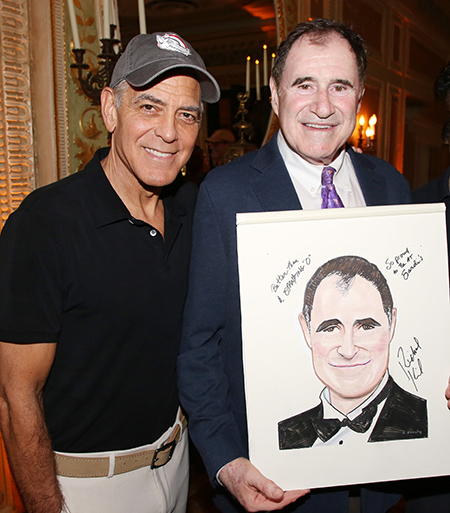
George Clooney, left, and Richard Kind pose at a portrait ceremony honoring Kind at Sardi’s restaurant in New York City on June 6, 2025. Credit: Bruce Glikas/Wireimage
Kind didn’t become a mammoth star à la Clooney, but he got consistent work, appearing on Carol Burnett’s variety show and big ’90s sitcoms like Mad About You and Spin City. “A journeyman actor just keeps working,” Kind says. “You don’t have big breaks — you just have milestones.”
For all his TV and film credits, though, Kind most enjoys the thrill of live theater. “I like doing musicals that are really hard,” he says. “I really like being onstage for a drama or a musical for that concentrated hour and a half, two hours where you have to be on the line for that moment, versus doing movies or TV where it’s not as concentrated.”
He’s had his share of stage time. Kind earned a Tony nomination in 2013 for his role as Marcus Hoff in The Big Knife. He played Ira in the Broadway production of Charles Busch’s play The Tale of the Allergist’s Wife in the early 2000s. Busch ’76 then cast Kind as a Nazi in a 2007 production of his slapstick play The Lady in Question. Kind also played Max Bialystock in the Broadway and Hollywood Bowl productions of The Producers.
“He really is a throwback to the great comic players,” Busch says of Kind. “There’s a lovable madness to him.”
Brian d’Arcy James ’90, Kind’s co-star in a Broadway production of Dirty Rotten Scoundrels, attributes Kind’s stage success to his “fierce respect for the craft of what it takes to be in theater,” an attribute nurtured at Northwestern.
“It’s not lightning in a bottle,” says James, who appeared with Kind at the School of Communication’s 2018 star-studded gala, A Starry Night.
“Some people are really good-looking and get thrust into a career, and they’re not as good as they should be because they haven’t been given the opportunity to work as hard or to fail,” Kind says. “I got practical training at Northwestern.”
Despite his success, Kind insists that the theme of his life story ought to be “how not to be a star.” And he likes it that way. (In fact, in early 2025 Kind performed his live stage show How Not to Be Famous: A Conversation With Richard Kind in select U.S. cities.)
“When a big star gets hired for a project, there is so much pressure on that person to hold the production together,” he says. “I walk on the set and I go, ‘Where do you want me? What do I do?’ And then I go home. Nobody counts on me. It’s very easy. I just do me.”
Kind says he has one role left on his bucket list: attorney Roy Cohn in Tony Kushner’s two-part play Angels in America. But ultimately, he’s happy to have a reliable, sustained career as an actor, taking on whatever role is thrown at him.
“Whenever I get a part,” he says, “I always go, ‘Oh, this is the best part. I’m so glad I get to play it.’”
In other words, Kind is living the dream. “People ask, ‘Hey, are you still doing TV?’ I mean, I’ve been on 8,000 programs in the last year. I go, ‘Just sit on your couch and watch. I’ll be there!’”
Brenna Ehrlich Enos ’07, ’08 MS is chief research editor at Rolling Stone, where she also writes about music, entertainment and true crime. She lives in Hackensack, N.J.
Check out these related stories...
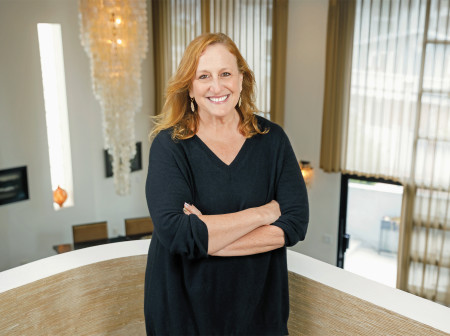
Meet the 2022 recipients of the NAA’s highest honor, the Northwestern Alumni Medal: ‘Sex and the City’ writer Cindy Chupack ’87, broadcasting veteran David Louie ’72 and Inclusive Capital Partners founder Jeff Ubben ’87 MBA.
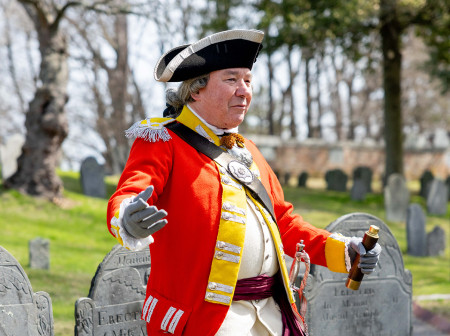
Lee Wright ’87 MBA turned a curiosity about his 1780 home into a passion project for public history, leading him to found The Pursuit of History. His 10-year project offers immersive visits to historic sites, helping people understand both the prominent and everyday lives of American citizens.
Meet the three accomplished alumnae who will receive the Northwestern Alumni Association’s highest honor, the Northwestern Alumni Medal, in October. They will join a select group of 103 alumni — from innovative entrepreneurs and Supreme Court justices to award-winning writers and a Nobel Prize recipient — who have received this award since 1932.
Reader Responses
I greatly enjoyed your cover story on Richard Kind for two reasons. First, Richard and I were classmates, and I fondly recall him as a hysterical and wonderful guy back then. Second, I'm a huge fan of his
performances, which I try to catch whenever and wherever they are on screen or onstage.
He's one of many remarkable performers who've been launched at Northwestern, but he's also one of a kind.
—Richard Eisenberg '78, Westfield, N.J., via Northwestern Magazine
I sat next to Richard Kind ’78 in one of Irv Rein’s communication studies classes during winter quarter 1978. Professor Rein assigned the task of interviewing a “famous person” and writing a paper about the experience.
The following week Rein read a paragraph from every paper to the class. Most interviewees were local TV, radio and newspaper celebrities, as well as a few Northwestern bigwigs. He saved Richard Kind’s paper for last. After a short buildup, Rein announced Richard’s interviewee: Joan Rivers. We were stunned. I looked at Richard and said, “Joan Rivers? Really?” He shrugged and said, “Yeah.”
Rein asked Richard how he managed it, and Richard regaled us with how he had staked out the lobby of the Drake Hotel (she was appearing onstage downtown), waited for her to come in, walked up and asked her! Richard’s big personality being what it was — and still is — she agreed. And naturally, his interview was a hit with the class. One of my favorite memories of Northwestern.
—Margie Davis Riordan '78, St. Petersburg, Fla.
No one has commented on this page yet.
Submit a Response