
When Joel Mokyr fired up his computer on Monday, Oct. 13, he noticed a few congratulatory emails. “I thought maybe people had mistaken my birthday,” he said later.
Then he saw a missed call from +46 — the country code for Sweden — and suspected something big might have happened.
Something big, indeed. Mokyr, the Robert H. Strotz Professor of Arts and Sciences and professor of economics and history at Northwestern, had won the Nobel Memorial Prize in Economic Sciences.
The Royal Swedish Academy of Sciences awarded the 2025 prize to three economists for showing how technological progress has led to sustained economic growth. Mokyr received half of the prize; the other half is shared by Philippe Aghion of the Collège de France and the London School of Economics and Peter Howitt ’73 PhD of Brown University. Howitt earned a doctorate in economics from Northwestern.
Despite being honored with myriad awards throughout his career, including being named a 2021 Citation Laureate — an international honor that is sometimes called a Nobel predictor — Mokyr believed his work was outside the Nobel Prize committee’s range of interests. In exchanges with colleagues about the possibility of winning a Nobel, Mokyr often joked: “I am more likely to be elected pope than win — and I am a Jew.”
Mokyr has taught economics and history at Northwestern for more than five decades. An expert on the economic history of Europe, specializing in the period 1750–1914, Mokyr identified three key requisites for growth: useful knowledge, mechanical competence and institutions conducive to technological progress.
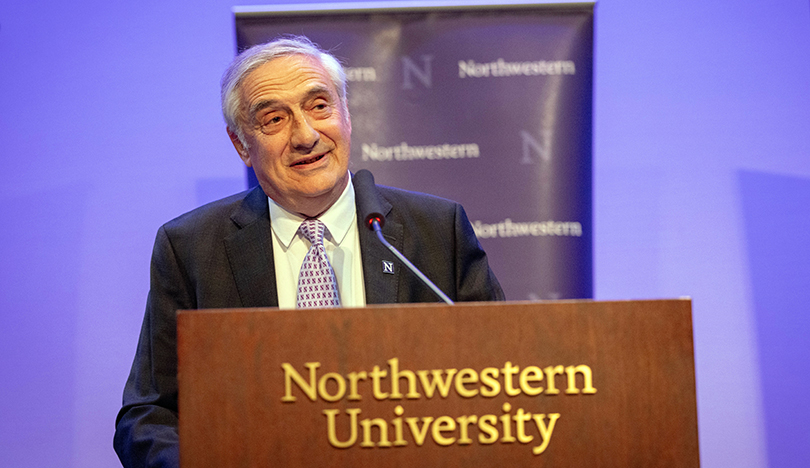
Joel Mokyr at his Nobel Prize press conference in October. Credit: Shane Collins
During his Nobel press conference at Northwestern’s Cahn Auditorium, Mokyr recalled a lesson from the late Nobel Prize winner Robert Fogel. “Economics must deal with economic history,” Fogel told Mokyr. “For economics to work without economic history is like evolutionary biology without paleontology. If you don’t have paleontology, you miss 99.5% of all of the species that ever walked this earth.”
Without studying the “economic systems, economic societies and economic interactions … that have disappeared,” Mokyr said, “we’re missing a great deal of what economics teaches us.”
Mokyr’s research focuses on changes in technology and economic growth, and his optimistic perspectives have been widely cited by major media outlets. His latest book, Two Paths to Prosperity: Culture and Institutions in Europe and China, 1000–2000, focuses on the cultural changes that determined the vastly different economic trajectories of these two civilizations.
With no plans to retire, Mokyr said, “One of the joys of my life [at Northwestern] has been training … brilliant graduate students,” many of whom are now teaching economics and history at top universities around the world. “Some of my students have their own students, and these students have their students, so I have intellectual great-grandchildren, which is kind of an awesome feeling.”
Mokyr is the fourth Northwestern faculty member to win a Nobel. In 2016 the late Sir Fraser Stoddart, the Board of Trustees Professor of Chemistry, was awarded the Nobel Prize in chemistry. In 2010 the late Dale T. Mortensen, the Ida C. Cook Professor of Economics, won the Nobel Memorial Prize in Economic Sciences; and in 1998 the late John A. Pople, the Board of Trustees Professor of Chemistry, received the Nobel Prize in chemistry.



Reader Responses
No one has commented on this page yet.
Submit a Response