
It took two plane crashes before Boeing was forced to truly look at itself.
When I stepped into my role as the company’s chief spokesperson in 2020, just eight months after the second crash, I realized something that has shaped my thinking ever since: The crisis didn’t create Boeing’s challenges. It made them impossible to ignore.
The warning signs were already there: the pressure from industry to move faster, the blind spots in how decisions were made. The crashes just tore away the facade.
And at that moment, Boeing had a choice. The same choice every organization — and every person — gets when crisis strips away appearances: Do we try to go back to the way things were? Or do we finally become who we should have been all along?
I’ve come to believe something that sounds almost cruel: Organizations and individuals are at their most malleable — their most honest, their most capable of real change — when faced with crisis. Not because crisis makes us better, but because crisis makes us vulnerable. And vulnerability is the only state in which real transformation is actually possible.
In 2025, when Harvard University faced controversies that threatened its credibility and its funding, the institution was forced to ask fundamental questions about purpose and mission that decades of prestige had allowed it to avoid. In the early 2000s, when drug manufacturer Baxter International faced a blood-contamination crisis that could have destroyed the company, CEO Harry Kraemer ’79 MBA — now a professor at the Kellogg School of Management — didn’t spin. He accepted responsibility, communicated openly and rebuilt trust through transparency that became a new standard in health care.
Neither Harvard nor Baxter changed because leaders suddenly woke up one morning with clairvoyance. They changed because an untenable situation forced them to acknowledge that what they had been doing wasn’t working.
Boeing is still in that window, working to prove they recognize that the 737 MAX crashes weren’t just a tragedy to be managed but a call to become fundamentally different — for their processes and culture reflect the level of safety they strive to achieve.
The question for each of us is not whether we will face crisis. The question is what we’ll do with it when it finds us.
The true test of crisis navigation is much more spiritual than practical.
It’s not about whether you can protect your reputation or manage the news cycle or satisfy your legal team, although these are all things you’ll need to do. It’s about whether the values you claim to hold actually guide your decisions when there’s no perfect playbook to follow. Whether the culture you’ve built can survive being examined in the harshest possible light. Whether you’re willing to look at what’s broken and name it, even when that means accepting that you were complicit in breaking it.
At Boeing, that looked like executives sitting across from families who’d lost everything and just … listening. No talking points. No deflection. Just the weight of what the company’s failure had cost them — and the commitment to ensure it would mean something.
I know personally what it means to be changed by loss.
Twenty years ago, I got a call that rocked my world to its core. One of my best friends had been killed in a drive-by shooting while sitting on his porch. He was 18 — dead on his doorstep with a bullet hole in his heart.
I had a choice in that moment that I didn’t fully understand at that time: I could let that loss break me, or I could let it shape me into someone who understood that time matters, that the work we do and the choices we make have weight because none of us knows how long we have to get it right.
I chose to keep moving forward. Not past it but through it. And that choice changed everything about how I view a crisis. It’s not something that happens to you and then ends. It’s something that reveals what matters and demands that you build your life around that truth. Attending Northwestern was a part of that for me.
Northwestern was an entirely different environment than the one I grew up in. The culture focused on asking questions and challenging assumptions and forced me to look past prior constraints I did not realize I had been putting on myself. And having so many clear examples of people who had succeeded in different ways gave me both a roadmap and the confidence I needed to change my life.
You might not ever run a big company like Boeing. But you will face moments when the ground shifts beneath you and people are watching to see what you’ll do.
Maybe it’s a failed project that exposes deeper problems with how your team operates. Maybe it’s a personal mistake that forces you to confront gaps between who you say you are and how you actually show up in the world.
You can try to get back to normal. Smooth it over. Wait for people to forget and move on.
Or you can do the harder thing: Accept that the crisis is showing you something true. That this moment — as painful as it is — is your chance to become something you couldn’t have been before.
The leaders I respect most aren’t the ones who’ve avoided disruption. They’re the ones who walked into it with their eyes open and came out changed. Who figured out where they actually stood — not where it was safe or convenient to stand, but where their values demanded they stand — and then stayed there when everything was on the line.
Crisis will come for you. For your organization. For the things you’ve worked to build.
And when it does, it will ask you a question more important than any strategic plan or playbook: Who are you when you’ve fallen down and the script is gone?
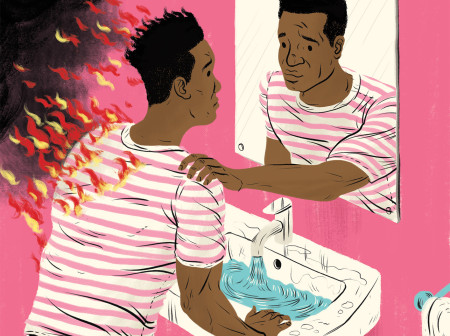
The people and organizations that endure aren’t just the ones with the best crisis manuals. They’re the ones who can look in the mirror when everything is falling apart and still recognize themselves.
Crisis doesn’t just test you. It reveals you. And if you’re willing to accept that invitation — to do the uncomfortable work of becoming who you should have been all along — it might be the most important thing that ever happens to you.
Bradley Akubuiro ’11 lives in Chicago, where he is a partner at Bully Pulpit International. He’s an adjunct lecturer in the Medill School of Journalism, Media, Integrated Marketing Communications and serves on the school’s Board of Advisers. He is the author of the forthcoming book Faster, Messier, Tougher: Crisis Communications Strategies in an Era of Populism, AI and Distrust.


Reader Responses
"Who are you when you've fallen down and the script is gone?" That question is central to all human existence. If we haven't faced it, we haven't lived.
—Jim Sanders '80 PhD, Elizabethtown, Pa., via Northwestern Magazine
Bradley Akubuiro's short essay on crises and what they do to us — or rather what we choose to do with them — hit home. Not quite as literally as plane crashes or gunshots that he's had to deal with, but having gone through major restructuring prompted by crisis in my own life, I punched the air at every other word. Thank you for the insights — and validating everyone's effort at gaining their own.
—Dragana Djordjevic '99 LLM, New York City, via Northwestern Magazine
No one has commented on this page yet.
Submit a Response