
A Nobel Honor
Professor of economics and history Joel Mokyr won the Nobel Memorial Prize in Economic Sciences. Mokyr has taught at Northwestern for more than five decades.
Nobel winner Joel Mokyr has spent decades studying the past. Now, he says, the future looks bright. By Stephanie Kulke
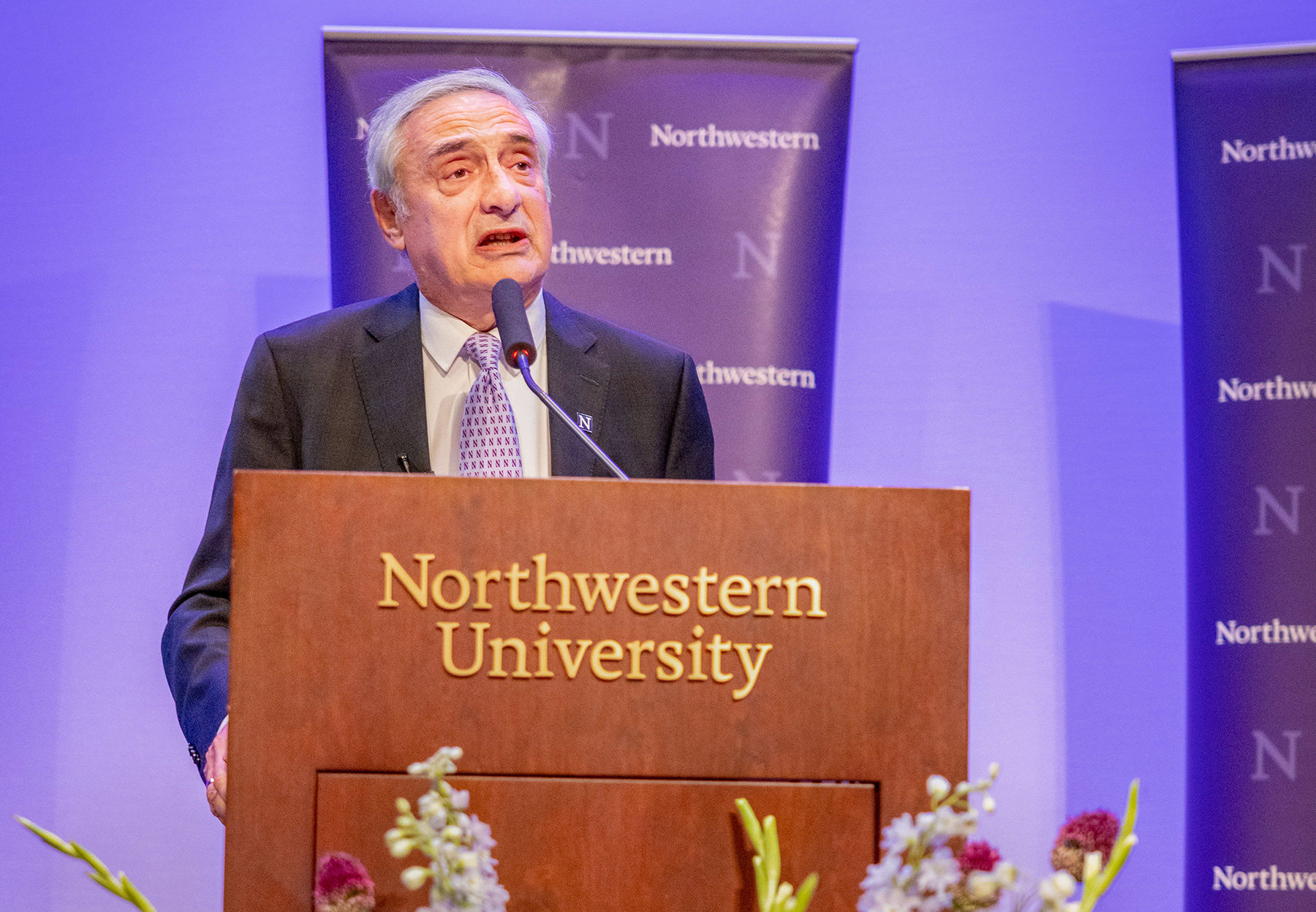
You might say that this lecture was Joel Mokyr’s largest ever. Last December the Northwestern professor stood before a lectern at the Nobel Prize banquet in Stockholm City Hall, prepared to address an audience of 1,300 dignitaries, fellow laureates and guests.
A professor of economics and history and the Robert H. Strotz Professor of Arts and Sciences at Northwestern, Mokyr received half of the 2025 Nobel Memorial Prize in Economic Sciences — sharing the award with Philippe Aghion of the Collège de France and Peter Howitt ’73 PhD of Brown University — for explaining how technological advancements make sustained economic growth possible.
Mokyr had identified three societal prerequisites for economic growth, based on his historical analysis of European civilizations. Aghion and Howitt had created a mathematical model demonstrating the theory of “creative destruction,” which posits that new knowledge about nature’s laws spurs innovations that drive new industries, replacing old, obsolete ones.
In his banquet speech, Mokyr described the positive aspects of creative destruction — advancements in science and medicine and global wealth, for instance. He also acknowledged its downsides — job elimination, environmental degradation and widening wealth gaps, among others.
Yet Mokyr is an unfettered optimist. His insatiable curiosity has led him to fearlessly challenge prevailing ideas about growth and uncover insights from history that have changed the world’s understanding of economic progress. You might say that he is the very personification of creative destruction.
True to form, as he looked out at the crowd, Mokyr was disarmingly direct and unreservedly bullish on his outlook for what lies ahead: “The best way to summarize our technological future is the American colloquialism ‘You ain’t seen nothin’ yet!’”
So how did Mokyr climb to such great intellectual heights? His origin story begins in Amsterdam during World War II.
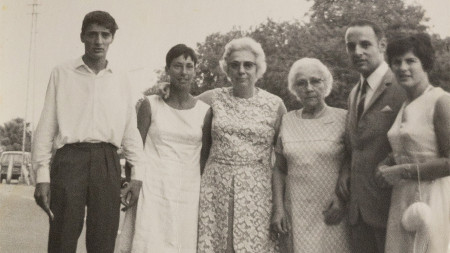
The Mokyr family after they moved to Haifa, Israel. From left, Joel; his sister (cousin by birth) Ada; Joel’s mother and grandmother; his brother, Rob; and his sister Miriam. Credit: Courtesy of Joel and Margalit Mokyr
Mokyr’s parents were Dutch Jews. In 1942 his parents and two older siblings were sent to Theresienstadt, a Nazi transit camp. They were liberated in 1945, but upon returning to the Netherlands, the family discovered that Mokyr’s aunt and uncle had died at Mauthausen in Austria. Mokyr’s parents had promised that, if they survived the war, they’d find and raise the couple’s baby daughter, who had been hidden by the Dutch resistance. His parents placed newspaper ads until they found her.
Mokyr’s parents decided to have another child they could raise alongside their 3-year-old niece. Joel Mokyr was born July 26, 1946, 14 years after his brother and a decade after his sister.
Soon after Mokyr was born, his father died of cancer, leaving behind a young family — and an extensive library on European and U.S. history. By age 5, Mokyr was reading his father’s books. “These were stories that happened,” Mokyr says. “I was utterly fascinated.”

Margalit and Joel at Hebrew University of Jerusalem in 1968. Credit: Courtesy of Joel and Margalit Mokyr
When Mokyr was 9, his mother moved the family to Haifa, Israel. He learned Hebrew, finished school and completed his military service. He then attended Hebrew University of Jerusalem, majoring in economics and history. It’s also where he met his wife-to-be, Margalit.
After completing his bachelor’s degree cum laude, Mokyr married Margalit, and they moved to New Haven, Conn., to study and work at Yale University. Joel earned his doctorate in economics, and Margalit was a senior lab researcher. They welcomed their first child, a daughter, in 1974. Later that year, the family landed in Chicago when Mokyr joined Northwestern’s economics department. They made their home in Skokie, Ill. With Joel’s support, Margalit completed her doctorate after the birth of their second daughter, finishing her dissertation in 22 months.
“He already had tenure, so he cared for the baby and the house and even typed up my dissertation on a word processor,” Margalit says. “I got tenure at the University of Illinois Chicago shortly after that.” She became a full professor (now emerita) of biochemistry and molecular biology.
“He’s smart, likes to cook and entertain, and is a great husband,” Margalit says of her spouse of 57 years.
Mokyr, sitting nearby, feigns amazement: “You never told me that!”
Although his father’s books had hooked him on history, Mokyr knew a doctorate in economics would provide other opportunities if he failed to make it as an academic. He found the sweet spot by studying economic history.
“Every area of economics has a past, from labor relations and strikes to tariffs and technology,” he says. He began to look at historical economic situations that are now rare to better understand how people and markets of the past functioned.
Economic historian Douglass North, a 1993 Nobel Laureate who had a significant influence on Mokyr’s work and in time became a close friend, believed that property rights drove prosperity. North theorized that the desire to define property as “mine or thine” incentivized the work required for ownership and drove economic growth.
Mokyr suspected that there was more to it than that. He focused his studies on the economic history of Europe from 1750 to 1914. He found that, for thousands of years before then, great civilizations had existed, but economic growth had remained stagnant. The knowledge of great thinkers was revered, and their teachings had been passed down through generations without question.
“In a society that has a huge amount of respect for the learning and wisdom of earlier generations, almost any innovation is going to be seen as heresy,” he explains. “And we know what past generations did to heretics.”
But things changed once discoveries showed that the world was different from what people had been taught — for example, a ship crossing the equator didn’t burn, as some Greek philosophers had predicted. When people realized that ancient views of the universe were incorrect, this realization spurred out-of-the-box thinking and a quest for new knowledge, Mokyr says.
Mokyr’s insight led to his articulation of the first of three key elements in his theory of economic growth: useful knowledge.
“If not for skepticism of knowledge from previous generations, we’d still be practicing 1,500-year-old medicine,” he says. “Given the choice, would you rather see a dentist with today’s knowledge and tools or someone practicing dentistry as it was done 1,500 years ago?”
In addition to new knowledge and a desire for progress, people needed the mechanical competence to bring new ideas to fruition, says Mokyr. This understanding led Mokyr to his second requirement for economic growth: skilled labor.
People initially learned trade skills through apprenticeships. But as the marketplace of ideas became more competitive in Europe, demand grew for institutions to disseminate knowledge and sustain innovation. Schools and universities gradually embraced this role.
Mokyr’s third prerequisite for economic progress is institutions that incentivize technological advancement. Instead of treating knowledge seekers as heretics and burning them at the stake, society developed positive incentives to motivate people to do the hard work of science.
Those incentives continue to this day, says Mokyr. “In industry, inventors are rewarded with money and a patent,” he says. Likewise, academics are rewarded with a stable income and recognition for intellectual achievement. “We academics wouldn’t know what to do with a billion dollars,” he says with a shrug. “Maybe hire another research assistant?”
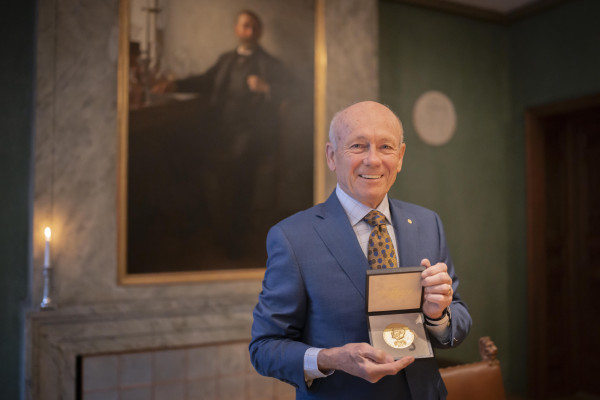
Peter Howitt ’73 PhD, professor emeritus of economics at Brown University, shared the Nobel Memorial Prize in Economic Sciences with Joel Mokyr and Philippe Aghion. Howitt collaborated with Aghion on a 1992 paper on creative destruction.
Howitt recalls many happy memories from his time as a Northwestern graduate student, starting with painting the walls of a newly rented apartment on Washington Street in Evanston with his wife of three days. “Believe it or not, it was a joyous honeymoon, and we are still married,” he says.
He fondly recalls the weekly macroeconomics seminars held at 629 Noyes Street, an old house where many of the professors’ offices were located. “I learned as much there as I did in any classroom, and that’s where I really felt most at home. “Northwestern is where I learned that I wanted to become a professional economist — that I enjoyed the fellowship of economists and enjoyed the mental work involved,” Howitt adds.
In a full-circle moment, the Nobel Prize winner returned to Northwestern to deliver a public lecture hosted by the Department of Economics in March.
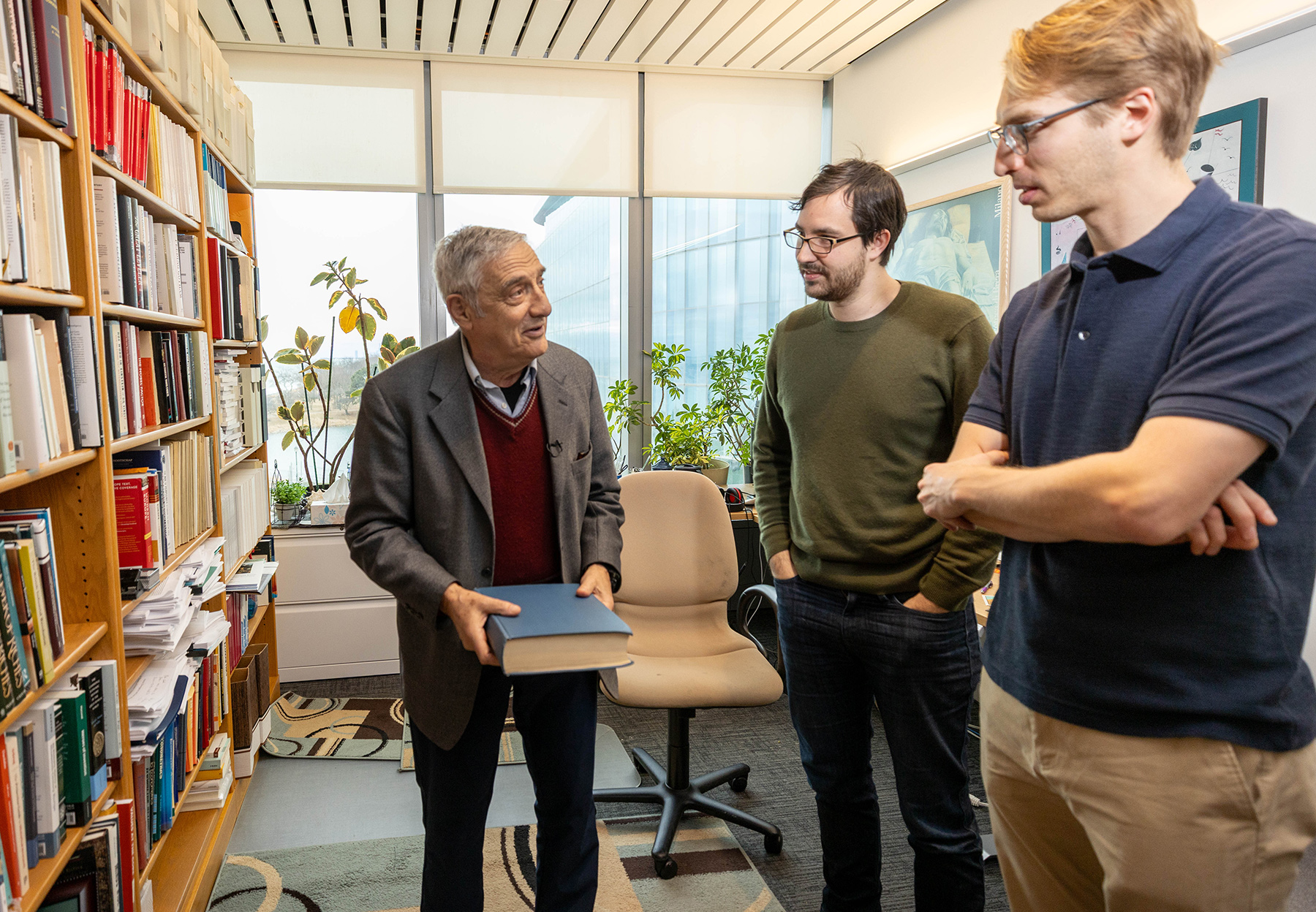
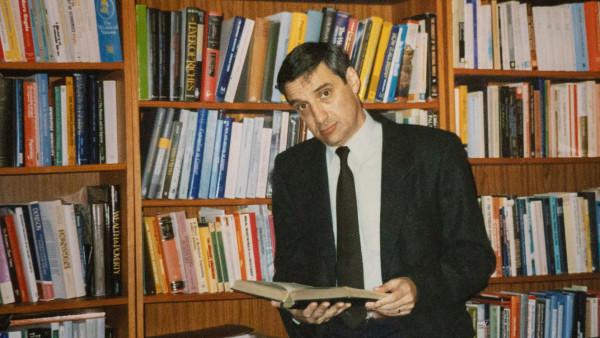 Mokyr still gets as much joy from teaching as he did when he arrived at Northwestern 52 years ago. “I come overprepared for every class,” he says. “I want to walk out of class feeling … like I [hit] a home run.”
Although he admits to being lousy at sports — “always the last one to be picked for a team” — Mokyr makes up for it as a heavy hitter in two highly ranked departments at Northwestern: economics and history.
“Joel should be getting two salaries, that’s how strong his commitment is to both fields,” says Northwestern economics professor Joseph Ferrie, who has been Mokyr’s colleague for 35 years. “He is a unique character — he has tremendous enthusiasm and honesty. Both are important in a colleague.”
Macroeconomist Robert Gordon, the Stanley G. Harris Professor Emeritus in Economics, has forged a unique bond with Mokyr. “Our approach to future economic growth pits his cheery optimism against my multifaceted pessimism,” says Gordon. “As colleagues, this has led us both to debate and to recognize the partial merits of the other’s position.
“Everyone admires Joel’s creativity, his many books and discoveries, and his superb teaching ability,” he adds. “But what I most admire about him is … that he still bicycles four miles from his Skokie home to his Northwestern office in all but the coldest weather. He is both a towering intellect and a builder of very strong legs.”
With his thorough analysis of civilization’s histories, Mokyr has helped explain the economic and intellectual roots of technological progress in European societies and, more recently, China. His research has also focused on the global impact that industrialization and economic progress have had on the average human lifespan and quality of life.
In the past, “people lived short, painful lives,” he says. “They were crawling with insects and on the verge of subsistence. If the harvest failed, famine would kill millions. Poor nutrition and childhood disease caused stunting, both physical and mental.”
At a Northwestern symposium, Mokyr noted, “The last 150 years have been absolutely miraculous in the history of the human race. Living standards that would have been unimaginable in the 1870s have been attained not just by the very wealthy but, basically, by regular citizens. … We have doubled global average life expectancy.” In the 1870s the average lifespan was in the upper 30s, Mokyr explains. Today it is 76 for women and 71 for men.
Some economists have theorized that the greatest period of economic growth is behind us — that the lower-hanging fruit of technological growth has already been picked, so to speak.
With his irrepressible optimism, Mokyr takes the opposite view. “My argument is that science creates ladders,” he says. And with those ladders, “high-hanging fruits get easier to reach. And what’s more, the best fruits are at the top of the tree — and the tree is still growing.”
Mokyr concedes that new technologies often come with unforeseen costs. “Plastic, asbestos, leaded gasoline — all are miraculous but have created major problems. Technology surprises you, sometimes in a negative way,” he says. “We must keep inventing to mitigate the side effects.”
As old technologies and knowledge become obsolete, people may need to learn new skills. Many have expressed fears about the rise of AI and its potential to replace humans. For those who fear a dystopian future with robot overlords, Mokyr suggests they have been watching too many science fiction movies.
“AI cannot replace human intelligence,” he says. “It can never incorporate human conditioning and drives. Can AI compose an original symphony under the weight of unrequited love like Berlioz? Can AI have nationalistic feelings or write a novel about what it’s like to be under the rule of another country?”
Technology, he adds, is only a tool. “It’s never you. It’s always separate from you.”
Ultimately Mokyr believes continued technological progress is the answer to the “unprecedented existential threats” facing humanity today, including climate change, future pandemics and an aging population coupled with a declining workforce. “The only solution is to adapt and invent ourselves around these problems,” Mokyr said during his Nobel Prize banquet speech. “History exemplifies how … ingenuity has solved the technical challenges of society, from smallpox vaccination … to cancer therapy. It must continue to do so — because any alternative will be disastrous.”
Longtime Northwestern colleague Robert Coen ’64 MA, ’67 PhD, professor emeritus of economics, says, “Joel is one of the top in the world in terms of producing scholars who go out and teach economic history. The list of students whose dissertation committee he has served on or chaired is very long, and those students have gone on to high-quality institutions all over the world.”
One of Mokyr’s strongest points of pride is his legacy of “academic children,” including MacArthur “genius grant” recipient Avner Greif ’88 MA, ’89 PhD, co-author of Mokyr’s most recent book, and Ran Abramitzky ’00 MA, ’05 PhD, a senior associate dean at Stanford University.
Greif affectionately recalls Mokyr’s tough-love approach as an adviser on his dissertation, a study that combined game theory and the Cairo Geniza collection of 11th- and 12th-century documents related to long-distance trade.
“Joel told me that he knew nothing about either 11th-century trade or game theory but he was willing to read my work and give me feedback,” Greif recalls. “When I submitted to Joel the draft of my first paper, he returned it with the comment, ‘There may be some good ideas here, but you hide them well.’ This motivated me to work harder and succeed. I had served in the Israeli army, was a father of two, had master’s degrees in history and economics. I could stomach his constructive criticism.”
Mokyr also “gave me a key to his office and allowed me to use his extra computer,” Greif says. “My wife and I had two babies in our two-bedroom dorm, so being able to use his office was a great help.”
Along with his Nobel, Mokyr’s connections with his students are the highlight of his career. “My students are my legacy,” he says. “Books and prizes are one thing, but I’m most proud of my intellectual great-grandchildren — students who have students of their own who have students of their own.”
Stephanie Kulke ’21 MS is an editor in Northwestern’s Office of Global Marketing and Communications.
Check out these related stories...
Professor of economics and history Joel Mokyr won the Nobel Memorial Prize in Economic Sciences. Mokyr has taught at Northwestern for more than five decades.
The advance of science and technology has brought remarkable gains over the last two centuries. But how do we measure the importance of research and the return on R&D investment? Professor Ben Jones has been working with colleagues to answer these questions.
In 13 years as Northwestern University president, Morty Schapiro transformed the campuses, expanded international opportunities and supported faculty research — all while diversifying the student population. The University also faced financial challenges and several controversies, as well as an unprecedented pandemic. But, thanks to Schapiro’s leadership, Northwestern now stands as an internationally recognized research powerhouse that attracts top students and faculty from all over the world.
Reader Responses
I've always considered it an honor to have had Joel as my PhD adviser, to work with him as a colleague, and to have him as a lifelong friend. It's gratifying to see him and his work get this justly deserved recognition.
—Lynne Kiesling '93 PhD, Chicago, via LinkedIn
No one has commented on this page yet.
Submit a Response