
Understanding Uncertainty
Two professors work to better visualize probability for the next election.
Historian Margaret O’Mara discusses the evolving ties between government and Big Tech. By Jen Kirby
Last September, leaders of the top U.S. tech firms gathered for a White House dinner. Those executives — who also happen to be some of the world’s richest men — praised President Donald Trump and promised to invest in the United States, including millions for data center construction and outlays for operations and hiring. The scene was something of a sequel to Trump’s inauguration earlier last year, where many of the same CEOs sat front and center at the swearing in. The conspicuous presence of tech giants signaled the industry’s eagerness to align with the new administration — and to exert its influence on federal government policy.
Business and tech leaders have always tried to win favor with the White House, says Margaret Pugh O’Mara ’92. But under Trump, this effort has become even more explicit. “They’re making sure their companies are not on the wrong side of the Trump administration at a time when being on the wrong side … has really serious business consequences,” O’Mara says.
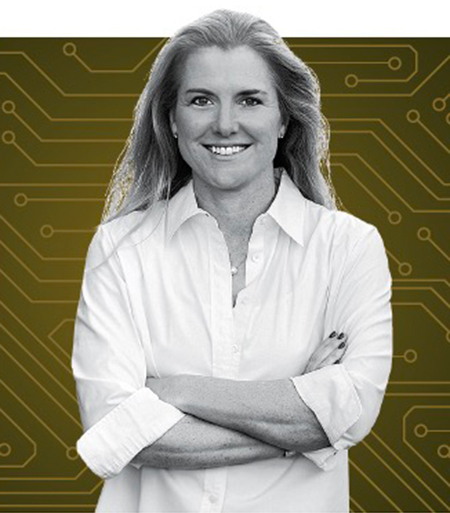
Historian Margaret O’Mara ’92. Photo Credit: Jim Garner
O’Mara is the Scott and Dorothy Bullitt Chair of American History at the University of Washington. She studies the intersection of politics and technology, an area that first captured her interest as a history and English major at Northwestern. Her 2019 book, The Code: Silicon Valley and the Remaking of America, examined the push and pull between industry and government during the Cold War and how that gave rise to the modern Silicon Valley. Her research explores how the U.S. tech industry has intertwined itself with public policy, often in ways that contradict the Valley’s self-mythologizing as a disruptive, free-market miracle.
That dissonance carries through to today, as tech titans rapidly advance their vision for the future of technology in areas such as artificial intelligence and cryptocurrency while deploying their astounding personal fortunes to advance their personal and ideological interests.
Northwestern Magazine spoke with O’Mara about how tech leaders’ unprecedented influence is reshaping the United States and its body politic and what lessons from history can help us make sense of this current moment.
The closest comparison is the Gilded Age, which marked the rise of the 19th-century titans of railroads and steel and banking. Standard Oil’s John Rockefeller was a billionaire. But when we compare his wealth to the fortunes of today and the global reach of these American companies, it really makes the Gilded Age seem quite small. We don’t have a precedent for it.
Tech leaders hanging at the White House is not a new thing, but bringing in someone like Elon Musk to do this hypervisible Department of Government Efficiency enterprise during the first few months of the Trump administration is new. This hyperpartisan stance that some tech executives, Musk included, have taken is new. We have not had this explicit “I’m endorsing this person. I’m going to devote the social media platform I own to push this person and their politics.”
Before, it was much more low-key. A lot of Silicon Valley people felt the government was the problem, not the solution, and the best they could do was keep it as far away as possible from their business.
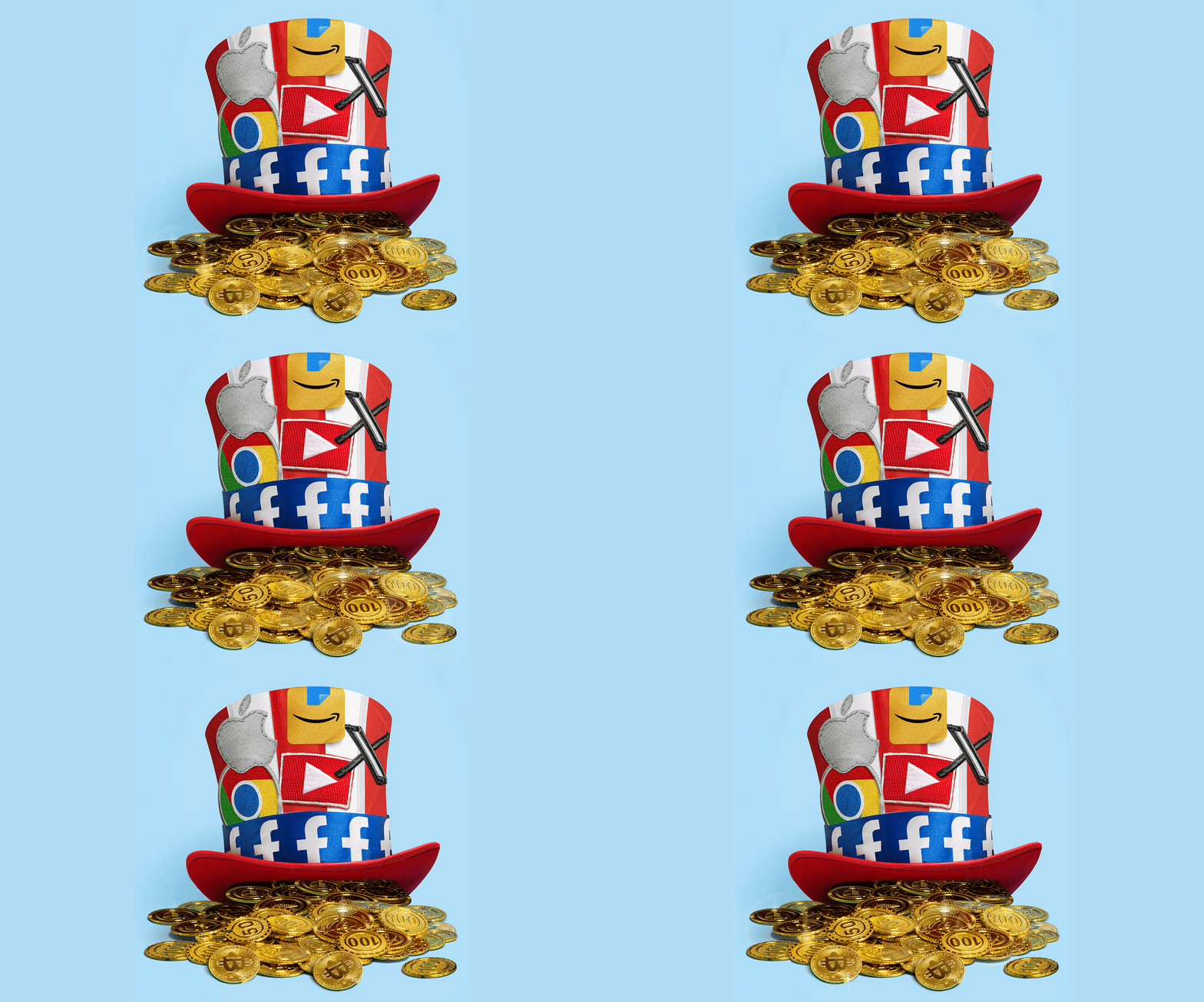
AI is a great example. The tech executives who’ve been in Trump’s favor have very successfully argued for what, at the moment, seems to be a regulatory environment that’s designed and dictated by the AI companies themselves.
Unlike the dot-com boom or even the personal-computer boom, the rise of AI is a revolution that requires massive, massive amounts of capital — such as capital for data centers, for chips. AI companies need the government to be an investor in this.
That’s why these individual leaders and investors are working so hard to get in Trump’s good graces — so they will have a hand in what the future of AI will be. And sure enough, the government has promised investment for data infrastructure, such as lifting roadblocks to allow for more data center construction and energy use. It’s a super pro-industry environment.
In the dot-com era, the government created the rules of the road. The internet was a piece of public infrastructure made available for commercial use. A lot happened behind the scenes politically with the development of the internet to create this platform for the free flow of information.
That’s not what we’re doing now with AI. At least on the federal level, this is being done in a largely unregulated environment.
We have this quintessentially American model of government engagement in private markets and private industries, particularly the tech industry. That can include the government getting out of the way — or creating incentives to help certain industries grow.
In my 25-plus years of studying this history, I’ve learned that it has been a loose relationship. The state played a huge role. But it wasn’t breathing down the neck of entrepreneurs. It wasn’t trying to take a cut. This gave room for enterprise and market competition to flourish.
The analogy I use is an old-fashioned sandbox, where the government is building the wooden frame and pouring the sand in, and kids go in and build sandcastles and throw sand at each other. They’re allowed to create on their own terms but with resources provided by public policy.
But this profit grabbing — that’s not something the government has done before. In innovation-driven industries, where companies are dependent on developing next-gen technologies and they’re taking risks in developing those, if you have a government stakeholder that’s putting rules and expectations in place, independent of market forces, there’s no guarantee that you can keep that fantastic entrepreneurial energy going.
The American model over the past 80 years had internationalism as its foundational tenet. It was an understanding that science and the pursuit of knowledge could itself be soft diplomacy, and bringing foreign students and scholars to train in U.S. universities could be an effective form of soft power, particularly during the Cold War.
It has been richly proven that incentivizing incredibly bright people from all over the world to come to the U.S. to study and to start entrepreneurial enterprises has been a critical component — if not the secret ingredient — of why American tech has been so dominant.
Immigration has been this incredible engine. A great example is Sergey Brin, co-founder of Google, who is the child of Russian émigrés. Same with Andy Grove, a Hungarian refugee who was CEO of Intel from 1987 to 1998.
We can’t predict what the future is going to bring. But American innovation rests on this very international foundation of people who’ve come here from around the world.
We are in this uncharted territory when it comes to the dominance of an algorithmically manipulated news and information environment. These algorithms operate in a black box. But certainly it’s been made clear that there has been a deliberate effort to engineer the algorithm to favor certain types of information that produce engagement. All the platforms are engineered to build outrage, because outrage brings eyeballs, and eyeballs sell ads. That does change the dynamic of what’s getting covered and emphasized.
Here’s the analogy I’ve used: It’s a runaway train. These social media companies were spectacularly successful. The train started gathering speed, and the engineer at the helm, in this case, Meta’s Mark Zuckerberg, didn’t have the capacity or the will to slow it down. Also, the fast train was making lots of money. If you’re a publicly traded company, you’re not going to do things to hack into your profitability.
Perhaps we will reach a tipping point where the “enraged to engaged” social media model isn’t working anymore and something has to give. I would imagine there’s money to be made in creating a more sane and rational information environment that’s rich in quality. I’m curious to see how today’s college students, who have been navigating this from the very beginning, will attempt a reset. Will they navigate it better than previous generations?
Bigness creates backlash. We saw this during the Gilded Age. When a few companies have too much control over markets, public and political opinion sours on them. We saw this in the past decade with the so-called “techlash” around social media companies.
How did the first Gilded Age end? After a long period of reform and steady efforts to build up government capacity to wisely regulate — not overturn — the capitalist system.
There was great concern about the survival of democracy with such extreme polarization of wealth. Leaders of progressive reform were mostly middle-class professional elites who realized it was in their economic and political interest to even out the playing field — that that would help foster a stable society of opportunity and growth.
Progressive reform began in part at the local and state level with labor laws in the early 1900s. That percolated for decades and became national and institutionalized in the 1930s with the New Deal, after the Great Depression. I hope it doesn’t take a global economic meltdown to effect a fairer system today. The American experiment has been remarkably durable despite the many adverse headwinds it’s experienced over almost 250 years. This too will pass, but not by us sitting back and holding our breath. It will require the work of many people, including the people at the very top of Silicon Valley. They have a responsibility that comes with their great power and wealth.
Jen Kirby ’13 MS is a freelance journalist based in New York City. She writes about foreign policy, national security, politics, human rights and democracy.
Check out these related stories...
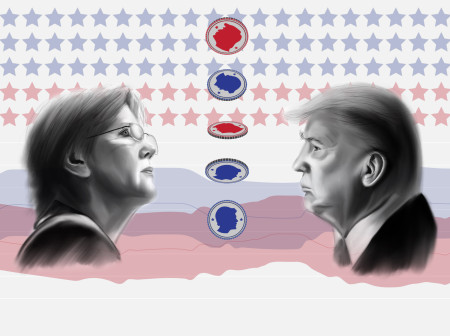
Two professors work to better visualize probability for the next election.
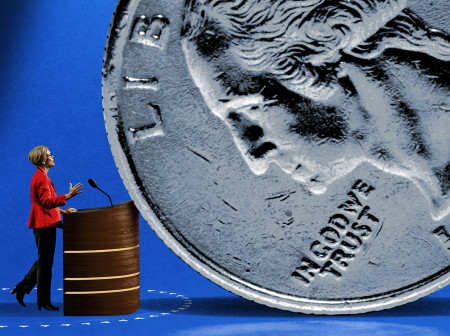
Northwestern researcher Galen Bodenhausen says that despite women’s political gains, an economic crisis can spark gender stereotyping.
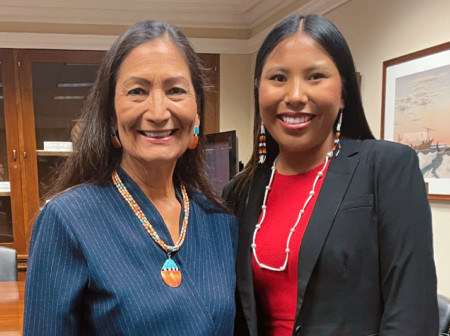
Isabella Twocrow interned for 10 weeks with the Bureau of Indian Affairs, working alongside some of the most important decision-makers when it comes to Native American life, including Secretary of the Interior Deb Haaland. “They’re the people protecting tribal sovereignty through policymaking,” says Twocrow, who is Oglala Lakota and a member of the Ho-Chunk Nation and co-chair of Northwestern’s Native American and Indigenous Student Alliance.
Reader Responses
Very well stated. The Trump administration is supporting tech progress and aims to keep America great.
—Jay Mainthia '72 MS, Fullerton, Calif., via Northwestern Magazine
No one has commented on this page yet.
Submit a Response