Sadiya Khan ’05 helped develop a tool to predict and prevent cardiovascular disease.
By Clare Milliken
Image: Paul Garland
In a single day, your heart pumps around 100,000 times, circulating about 2,000 gallons of blood through your body — enough to fill an 8-by-10-foot swimming pool.
This muscular, fist-sized organ is the centerpiece of the cardiovascular system, a 24/7 courier service delivering oxygen and nutrients to your organs and tissues and carrying away waste through roughly 60,000 miles of blood vessels.
Ideally, this system runs like clockwork, without us having to think about it — though Northwestern’s Sadiya Khan ’05, ’09 MD, ’12 GME, ’14 MS, ’16 GME would argue that we should all give it a little more thought.
That’s because cardiovascular disease (CVD) is the No. 1 cause of death worldwide, accounting for 1 in 3 deaths globally. In 2024 more people in the U.S. died of CVD than from cancer and accidents combined.
Risk factors for CVD include obesity, smoking and a sedentary lifestyle. Other important risk factors — high cholesterol, high blood pressure and uncontrolled diabetes — can be silent: People may not know their levels are high until they experience a heart attack or stroke.
CVD encompasses all diseases that affect the heart and blood vessels, including coronary heart disease, heart attack, stroke, arrhythmia and heart failure. Many people believe these issues arise only in middle or old age.
But in truth, “risk begins early in life, even before age 40,” says Khan, the Magerstadt Professor of Cardiovascular Epidemiology in the Feinberg School of Medicine. “You don’t just wake up one day at 65 and have a heart attack. It’s something that has been building for a long time. So the earlier we can pick up on the risk, the better we can reduce that risk.”
This begs the question: How can we know if we’re at risk ... and what can we do about it?
Khan, who specializes in the prevention of CVD in both individual patients and broader populations, has dedicated her career to finding the answer. Inspired by her father, who was a primary care doctor for 45 years, Khan pursued her medical education and clinical training at Northwestern, earning a bachelor’s degree in biomedical engineering, followed by her medical degree and a master’s degree in clinical investigation. She also completed a residency in internal medicine and a fellowship in cardiovascular diseases at Northwestern-affiliated hospitals.
After meeting a cardiologist who specialized in heart failure — a chronic condition that occurs when a person’s heart cannot efficiently pump blood throughout the body — Khan planned to become a cardiologist specializing in advanced heart failure. But treating heart failure meant “we were always trying to catch up to damage that had accumulated over years or decades,” she says. “Being able to focus on prevention felt like an opportunity to make the greatest difference.”
So Khan looked for a way to help patients before the onset of heart failure. She became laser-focused on the idea that cardiovascular disease could be predicted and, importantly, prevented.
And in 2023, she worked with the American Heart Association (AHA) to develop a tool to prove it.
Drawing on decades of research and carefully synthesized data from over 6 million adults, Khan helped launch the AHA Predicting Risk of Cardiovascular Disease EVENTs (PREVENT) calculator, a free online tool that estimates an individual’s risk for heart attack, stroke and heart failure over 10- and 30-year periods. Available on the AHA’s website, PREVENT has been shown to be more accurate than older prediction tools.
Khan’s groundbreaking work landed her on this year’s TIME100 Health list, acknowledging the most influential people in patient care, healthcare policy and medical innovation. She is now part of a team working to incorporate PREVENT into electronic medical record platforms. Slated for completion this fall, that project will allow primary care clinicians to seamlessly integrate the tool into patient care, Khan says.
She believes PREVENT can get people to talk about heart health — and make meaningful changes — before it’s too late.
“There are about 260 million people in the U.S. over the age of 18, and about 11 million have a diagnosis of some form of cardiovascular disease,” Khan says. “That means 250 million people could benefit from having a conversation about their cardiovascular risk and how to reduce the chance that they’ll get CVD down the line.”
THREE MAJOR TYPES OF CARDIOVASCULAR DISEASE
These account for the majority of CVD cases. Illustrations by Paul Garland
Coronary heart disease
Plaque buildup reduces blood flow to the heart. Plaque can also trigger blood clots that can cause a heart attack.
Heart failure
The heart muscle is too stiff or too weak to efficiently pump blood throughout the body.
Stroke
A blood vessel inside the brain bursts, or a blood vessel that feeds the brain gets blocked.
Image: Paul Garland
LONG-TERM RISKS
Alarmed by rising rates of obesity, diabetes and kidney disease starting in the late 2010s, a group of scientists from universities and medical centers across the U.S. established the framework for PREVENT.
Co-led by Khan, this group developed the new equations for CVD risk, selected the specific datasets to inform the tool and determined how to present calculations to patients and physicians. Khan was lead author on the AHA’s scientific statement announcing the new PREVENT tool in November 2023.
Whereas previous calculators only predicted risk of heart attack or risk of heart attack and stroke, PREVENT also predicts risk of heart failure, the rate of which increased 43% in the U.S. from 1988 to 2023.
PREVENT considers biological sex alongside standard CVD risk factors like age, cholesterol and blood pressure levels, and smoking status. It also accounts for body mass index, metabolic health and kidney function.
While other tools are targeted toward people 40 and older, PREVENT is intended for adults ages 30 to 79 who do not have known CVD. And while previous calculators only assess 10-year risk, PREVENT calculates both 10- and 30-year risk. Khan’s research shows that while most U.S. adults ages 30 to 59 have a low 10-year risk of CVD, about 1 in 7 have a high 30-year CVD risk.
“If I’m 35 with obesity, diabetes and high blood pressure, the odds of having a heart attack before I’m 45 are still pretty low,” Khan says. “But the odds that I have a heart attack before the age of 65 are actually pretty high. PREVENT can get people thinking about what they need to change today so that in 30 years that doesn’t happen.”
Professor Sadiya Khan demonstrates the American Heart Association’s Predicting Risk of Cardiovascular EVENTs (PREVENT) calculator, which she helped develop.
Image: Shane Collins
THE LEADING CAUSE OF DEATH IN WOMEN
“If you Google heart disease or heart attack, you get a picture of an older man clutching his chest,” professor Sadiya Khan says. “That sets up an entire structure of how women think about cardiovascular disease.”
While cardiovascular disease (CVD) is the leading cause of death in women, less than half of women recognize that. When surveyed by the American Heart Association, most women in the U.S. picked breast cancer as the leading cause. The actual ratio of CVD deaths to breast cancer deaths among women is approximately 10 to 1.
CVD is also a leading cause of pregnancy-related deaths in the U.S. In a 2022 study, Khan and colleagues found that approximately 60% of pregnant women in the U.S. have poor heart health. Better cardiovascular health during pregnancy is associated with better health later in life. Furthermore, babies born to mothers with poor heart health are more likely to be born early or have low birth weight, both of which can negatively impact a child’s long-term growth and development. A subsequent study co-authored by Khan also found a link between high blood pressure during pregnancy and poorer cardiovascular health among offspring decades later.
UNDERSTANDING THE NUMBERS
From the outset, Khan says, her research group made patient accessibility a critical attribute of PREVENT. The clinical information used to determine someone’s risk of CVD can be found in a standard lab workup that is part of routine primary care.
Khan and her team were equally intentional about how the tool presents its calculations. In addition to providing a person’s CVD risk, PREVENT also estimates the age of a person’s heart relative to their biological age — and their risk percentile relative to age- and sex-matched peers.
“Even doctors have a hard time explaining what 10-year risk means,” Khan says. “When you’re told that your 10-year risk of having a heart attack is 1%, that can be confusing. What a 10-year risk of 1% means is that if there were 100 people your age and sex who had the same exact numbers as you, over 10 years one of them would have had a cardiovascular event.
“That is a hard thing for anyone to understand, and understanding can vary depending on your level of health literacy,” Khan explains. “But if I tell someone that their heart age is five years older than their current age, that clicks.”
CHANGING SYSTEMS AND LIVES
For now, Khan and her team are focused on integrating PREVENT into routine patient care and incorporating the tool into electronic medical records.
“Next, we have to determine what the levers of change are,” she says. “We can put the best calculator in all the clinics, and the best doctors can explain it in the best ways. But if we can’t actually change individual and environmental factors, it’s all Band-Aids.”
In addition to her work on CVD prevention, Khan provides counseling and testing for inherited conditions related to cardiovascular disease. Her research also focuses on assessing specific risk factors for CVD in women, particularly pregnant and postpartum women.
Khan is adamant that a diagnosis of CVD is no one’s fault, and that reducing CVD rates is a society-level responsibility.
“A lot of conversations around cardiovascular health focus on the individual, but this is not about one person being motivated to change their behaviors,” Khan says. “We need to have a much broader conversation around the food environment and the activity environment that we live in. How do we actually change policy to ensure that we can support healthy lifestyle choices?
“We need to totally reframe how we talk about cardiovascular disease.”
At the same time, there are things we can all do to protect our cardiovascular health. Khan recommends following the AHA’s Life’s Essential 8. Even small tweaks, she says, can make a world of difference.
“What you change today matters,” Khan says. “The earlier you start, the more impact you can have. It’s never too early, and it’s never too late. Even if you’ve had a heart attack, the better your lifestyle, the better your blood pressure and your cholesterol going forward, the better you’ll do.”
Clare Milliken is senior writer and producer in Northwestern’s Office of Global Marketing and Communications.
EIGHT KEYS TO HEART HEALTH
The American Heart Association’s recommendations for improving and maintaining cardiovascular health
1. EAT WELL
Get plenty of fruits, vegetables, whole grains and unsaturated fats like nuts and seeds.
2. MOVE AROUND
Aim for 2.5 hours of moderate physical activity per week. “People who are sedentary are more likely to have higher blood pressure and a higher risk of diabetes,” says professor Sadiya Khan.
3. DON’T SMOKE
Avoid secondhand smoke too!
4. GET ENOUGH SLEEP
Most adults need seven to eight hours each night. “Sleep health is critical to your cardiovascular health,” says Khan.
5. CONTROL CHOLESTEROL
According to the American Heart Association, 1 in 4 U.S. adults has a high level of low-density lipoprotein — cholesterol that raises the risk of heart attack and stroke.
6. MANAGE WEIGHT
“Obesity leads to high cholesterol and diabetes and high blood pressure, but obesity itself is an inflammatory condition that causes stress on the heart,” Khan says.
7. MANAGE BLOOD SUGAR
Diet, weight and activity level all impact blood sugar levels.
8. MANAGE BLOOD PRESSURE
“High blood pressure is recognized and controlled in less than 30% of cases, and 120 million people in the U.S. have high blood pressure,” says Khan.
The effects of insufficient or poor-quality sleep go far deeper than our energy level the next morning. Sleep is a key component of our cardiovascular, metabolic and cognitive health, and at Northwestern, sleep research and circadian science — long regarded as disparate fields — come together to help us better understand how sleep can improve our health.
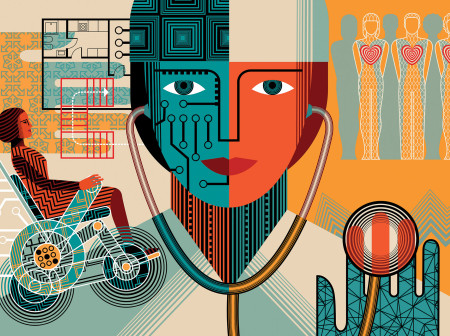
Artificial intelligence is all around us. And if AI is not already in your doctor’s office, you can bet it’s coming soon — with the potential to create major improvements in our health care and well-being.
Interdisciplinary teams of Northwestern scholars are working tirelessly every day on the foundational science that could help us live longer and healthier lives in a cleaner, more sustainable world. They ask big questions, follow their instincts and analyze data to solve tough problems and turn bold ideas into real solutions.
Never miss a Northwestern Magazine story:
Get the latest stories from the magazine in your inbox six times per year.
 Coronary heart disease
 Heart failure
 Stroke

 1. EAT WELL
 2. MOVE AROUND
 3. DON’T SMOKE
 4. GET ENOUGH SLEEP
 5. CONTROL CHOLESTEROL
 6. MANAGE WEIGHT
 7. MANAGE BLOOD SUGAR
 8. MANAGE BLOOD PRESSURE

Reader Responses
No one has commented on this page yet.
Submit a Response