
During halftime of the Illinois-Northwestern football game in 1941, Wildcat star halfback Ira “Ike” Kepford ’42 made a momentous commitment: He joined the U.S. Naval Aviation Reserve during an induction ceremony. It was Saturday, Nov. 22, just 15 days before Japan’s attack on Pearl Harbor.
Kepford enlisted as a naval aviation cadet, and over the next two years, he trained with the elite pilots of Fighter Squadron 17 (VF-17, also known as “The Jolly Rogers”), one of the U.S. Navy’s greatest fighter squadrons of all time.
In November 1943 the VF-17 took part in Operation Cartwheel, an Allied attack on Rabaul, a heavily fortified Japanese military stronghold in the Solomon Islands. Rabaul was home base for around 100,000 Japanese troops and a fleet of 250 to 300 aircraft.
The operation on Nov. 11, 1943, became one of the most important air-land-sea battles of World War II.
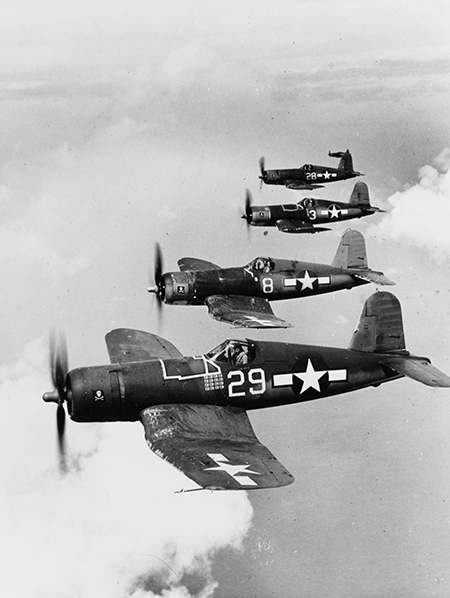
A group of U.S. Navy Corsair fighters fly over Bougainville Island in the Solomon Islands in 1944. Ike Kepford, then the Navy’s leading ace, piloted No. 29. The Japanese flags painted on his plane indicate Kepford’s 16 aerial victories. Credit: National Archives
Flying an F4U Corsair, Kepford and the Jolly Rogers were stationed at Ondonga Airfield in New Georgia in the Southwest Pacific. Awakened by reveille at 2 a.m., Kepford rose, ate and received his orders before a 4 a.m. takeoff. By 4:20 a.m., 24 Jolly Rogers were airborne and headed out to sea. Just before sunrise, they rendezvoused with three U.S. Navy aircraft carriers — USS Bunker Hill, USS Essex and USS Independence — that would launch 185 aircraft to attack Rabaul. The Jolly Rogers’ mission was to protect the carriers and their escorts during the attack. For the VF-17 pilots, this involved landing aboard the carriers to refuel and rearm.
Predictably, the attack on Rabaul stirred up a deadly hornet’s nest. The Japanese counter-attacked with over a hundred aircraft.
Shortly after 1 p.m., the Japanese airplanes came within 40 miles of the U.S. carriers. As the Japanese closed in, the U.S. F6F Hellcats joined the fight. The sky was filled with Japanese attackers and U.S. Hellcats and Corsairs. Dense anti-aircraft fire from the U.S. carriers complicated the perilous mission. Amid the chaos, Kepford engaged the Japanese bombers, scoring three aerial victories. He also shot down a Japanese torpedo bomber less than 1,000 yards from Bunker Hill.
At this point, Kepford was nearly out of fuel and 150 miles from the nearest shore base. He requested and received permission to land on Bunker Hill. Upon landing, Kepford’s Corsair had just 15 gallons of gas left — and 126 holes from enemy fire.
Kepford received a warm welcome from the ship’s commanding officer, Capt. John Ballentine, who said, “Welcome home, Ike. Bunker Hill thanks you and the rest of the Fighting Seventeen. I doubt we’d have made it without your help,” according to the book The Jolly Rogers: The Story of Tom Blackburn and Navy Fighting Squadron VF-17. After a 30-minute break, Kepford took off in a fully refueled, rearmed Corsair.
For the day, Kepford achieved the squadron’s high score with four aerial victories and one damaged aircraft, along with the squadron-high flight time of 11 total hours. VF-17’s tally for the day amounted to 18.5 victories and seven damaged Japanese warplanes.
Kepford and his fellow Jolly Rogers helped foil what could have been a devastating Japanese anti-carrier attack in the early days of the Pacific War. The U.S. claimed to have shot down 50 Japanese aircraft that day. The U.S. carriers lost 14 aircraft during the Japanese strikes, but the ships sustained no damage.
In January 1944, The Daily Northwestern reported:
Two years ago the name of Ike Kepford was headline news in the nation’s sport pages because of his exploits as a star halfback on Northwestern’s football team.
Today Ensign Ike Kepford is making new headlines in the Southwest Pacific where in a recent air battle over Rabaul his blazing guns sent four [Japanese] airplanes crashing into the sea in flames. … In a letter to Ade Schumacher, assistant athletic director at [Northwestern], he wrote: “Funny how cold and calm you are in a fight. It’s much the same feeling you have before the kickoff in a big football game. Everything I did seemed to come out clear as a bell, thanks to good Navy training and long hours in the air.”
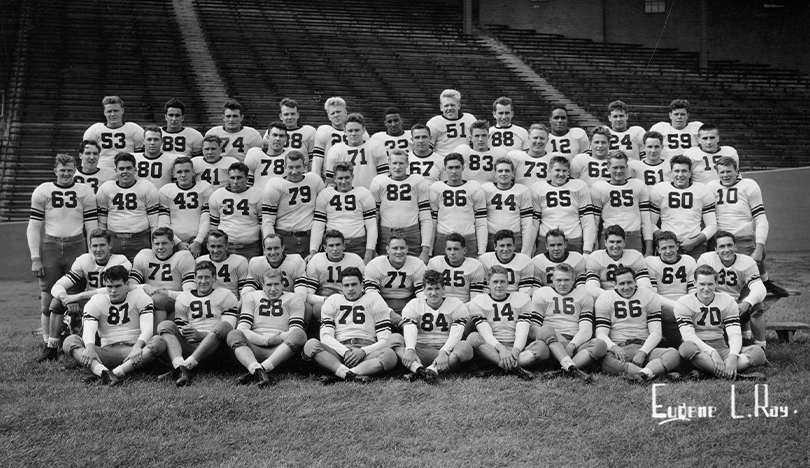
The 1941 Northwestern Wildcats football team. Ike Kepford (fourth from left in the second row) was a star halfback for the football team before joining the U.S. Navy Reserve. Credit: Courtesy of Daniel Moore
For most of 1944, Kepford was the Navy’s leading ace with a total of 16 aerial victories. He earned several U.S. military awards, including two Navy Crosses, a Silver Star and a Distinguished Flying Cross. Kepford also received a Northwestern Alumni Association Merit Award in 1944. Cmdr. Tom Blackburn, VF-17’s commanding officer, believed Kepford should have been awarded the Medal of Honor for his combat valor.
After the war, Kepford worked for the Liggett-Rexall drugstore chain, starting as a soda jerk in a Rexall drugstore and eventually retiring as president of Liggett Drug Co. in 1960. He died in 1987.
On Oct. 19, 2024, Northwestern Athletics honored Ike Kepford and his family with its Salute to Service during the Northwestern-Wisconsin football game.
Daniel E. Moore Jr. ’77 of Tucson, Ariz., spent 29 years as a U.S. naval aviator and served as commanding officer of Strike Fighter Squadron 81. He was commissioned through Northwestern’s Navy ROTC program. Moore is a former professor of naval science and former commanding officer of the Northwestern NROTC unit. This essay and the Northwestern athletic department’s 2024 recognition of Ike Kepford’s lifetime of service were made possible by the tireless efforts and encouragement of Northwestern historian Kevin Leonard ’77, ’82 MA.


Reader Responses
No one has commented on this page yet.
Submit a Response