
Sandy Weisz’s career is puzzling — quite literally.
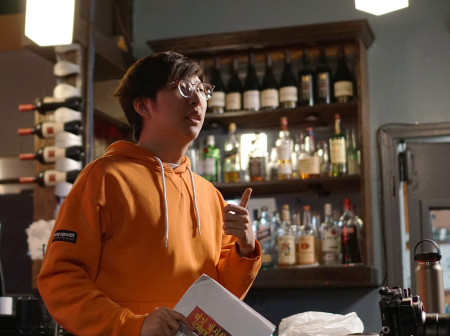
Weisz ’98 is founder of The Mystery League, a design studio that creates custom puzzle hunts and games for companies and other groups looking for fun team-building activities with a mysterious flair. Weisz, who revels in wordplay and riddles, also produces Raddle, an online daily word game that has attracted the attention of thousands. Northwestern Magazine’s Diana Babineau spoke with Weisz to find out more about the games he creates and what makes a well-designed puzzle so appealing.
What is Raddle?
I launched Raddle in March 2025. It’s a word transformation ladder game where each word changes into a new word at every step. There are clues that tell you how the words transform, but the clues are out of order, so you have to figure out which clue refers to which step. I have about 10,000 people a day playing Raddle. (Click here to play a Northwestern-themed Raddle.)
I love word puzzles because they demand a different connection in your brain every day. It’s a quick feedback loop: You see something. It’s difficult. You solve it. You feel good. Repeat.
I think people like the game because it’s got a voice, and people enjoy engaging with other human expression — each puzzle is a small work of art.
What is The Mystery League?
The Mystery League is a puzzle-making company I started in 2014 in Chicago. I design and stage live puzzle hunts for groups.
A puzzle hunt is kind of like a scavenger hunt, but instead of looking for objects, it’s a collection of puzzles, and figuring out how each one works is part of the challenge. You are given material that helps you extract a word or phrase from your environment or the materials you have, or both.
I’ve run puzzle hunts at the Field Museum, the Art Institute of Chicago, the Atlanta Motor Speedway and on a private jet. I’ve embedded puzzles in TV shows and in music. I even ran a hunt on the Evanston campus as part of the One Book One Northwestern program back in 2016. I do these hunts a lot for corporate clients as well, as team-building activities.
Where did your interest in puzzles come from?
As a kid I read Games magazine and was really into their puzzles. I was on the committee for social activities at a summer camp, so I built games and puzzles for all the campers. I also read If at All Possible, Involve a Cow: The Book of College Pranks by Neil Steinberg ’82 and loved it. Northwestern didn’t really have a subculture of elaborate pranks. But I lived in Communications Residential College on campus, and we did some goofy stunts.
How did you get into designing them yourself?
I was in my 20s, living in Chicago and working in web design. I gave myself a deadline of my 30th birthday to build my first hunt. It worked: When I turned 30, I put on my first puzzle hunt at that birthday for my friends, a lot of whom were from Northwestern. A lot of things went poorly. (I chose to do it outside, in November.) But I learned a ton. I kept doing more hunts and they got better and better.
What makes a puzzle fun for you?
The fun factor comes when you discover an elegant pattern in something inscrutable. The best kinds of puzzles are ones where two things naturally fit together in a way that you’ve never seen before, and they turn into a hidden message.
It’s very fulfilling to solve a puzzle. You’re in a state of confusion until you’re not. A puzzle can seem insurmountable until you find the “aha!” and then you break through. And hopefully, when you look back at all the clues, you recognize the path to get there was clear and available to you the whole time.
What effects do puzzle hunts have on your clients?
It’s a very democratizing activity, especially in a corporate environment. All of a sudden the thing you’ve been hired to do doesn’t matter — you’re all working on the same type of challenge. I’ve noticed that the employees who aren’t executives tend to excel because they are more detail oriented. It’s not actually that surprising that those in executive positions are not as strong at puzzle-solving; they’re more big-picture people.
What’s the most challenging part about designing a puzzle?
Finding the right level of difficulty for the audience. Some people might want it more difficult; others might want it easier. If you’re a new solver and you’re not familiar with the conventions and trappings of puzzle-solving, it might take you longer. But if there’s enough scaffolding there for you to latch onto and make your way to the end with some hinting, then at the end of it, however hard it was, you’re going to look back and feel like it was a satisfying experience. That’s what I use to measure the quality of my work.


Reader Responses
It's always great to see inspired, new puzzle ideas with a handcrafted feel. People who do this professionally know the goal is to write a puzzle that delights the player by providing just what they need to solve it. Sandy Weisz has done that with Raddle. I bet his Mystery League events are a blast too.
—Robert Leighton '82, New York City, via Northwestern Magazine
As a professional in the puzzle field, I was familiar with Sandy Weisz and his work with corporate games and puzzles, but I knew nothing about Raddle. Anyway, after four hours of solving, during which I blew off way too many calls and emails, I've determined it's an amazing puzzle.
When I speak about puzzles at conferences and events, many people ask me about the life of a puzzle creator. This article offers a lot of hope for dedicated creators who haven't found a foothold, as described in Weisz's journey. I will definitely point people to this article directly as well. I want creators in the puzzle community to feel inspired, and you have definitely caught this feeling within this piece.
—Jodi Jill Los Angeles
No one has commented on this page yet.
Submit a Response