News
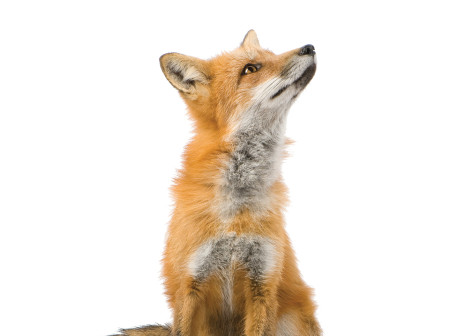
Last winter two beavers were spotted on the Evanston campus. University archivist Kevin Leonard ’77, ’82 MA says the Evanston campus has long been home to more than Wildcats, with bats, raccoons, skunks, “semi-domesticated” squirrels, foxes and coyotes living on or near campus.
Five Northwestern alumni and students share details on their Fulbright research, including river restoration and its impact on local fish populations in the United Kingdom, the evolutionary advances of an extinct family of giant clams in Poland and the burial practices of the ancient Aksumites in Ethiopia.

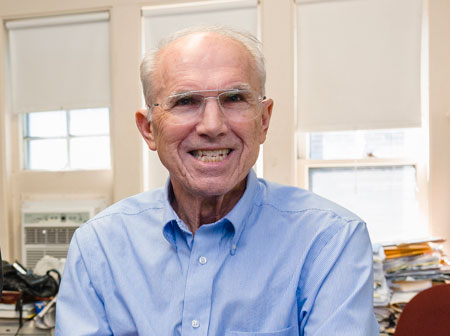
The year Irving Rein first taught his now-famous course Persuasive Images: Rhetoric of Contemporary Culture, the nation was engrossed in Woodstock, the first moon landing and the first draft lottery for the Vietnam War. Fifty years later, Rein is still teaching the course.
As they near the completion of their doctorates, Jennifer Ferrer and Arianne Rodriguez have faced their fair share of challenges. Lab work is rarely glamorous, and responding to carefully planned experiments gone awry can be difficult.

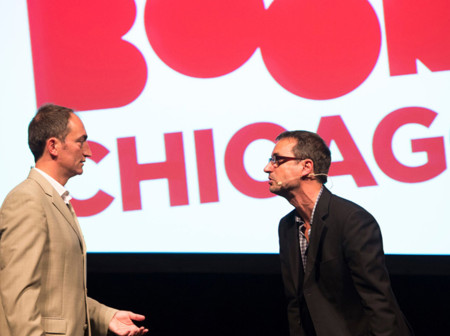
It started off as just another hazy post-graduation idea: Two Northwestern alumni traveling in Amsterdam decided to quit their jobs in the U.S. and move to the Netherlands to start an improv group.
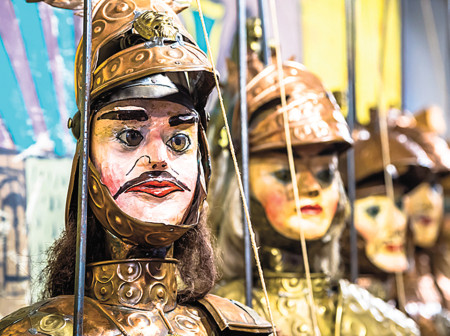
Five Northwestern students share their adventures from a summer abroad, including Shakespeare in marionettes, food culture in Italy, the effects of habitat degradation on Madagascar’s lemurs and assessing stress among Tsimané, an Indigenous group in lowland Bolivia.
“People have tried to classify personality types since Hippocrates’ time, but previous scientific literature has found that to be nonsense,” says William Revelle, professor of psychology and a self-proclaimed skeptic when it comes to personality types. So when his Northwestern colleagues Luís Amaral of the McCormick School of Engineering and Martin Gerlach, a postdoctoral fellow in Amaral’s lab, proposed a study to outline new personality types, Revelle, who specializes in personality measurement, theory and research, balked.

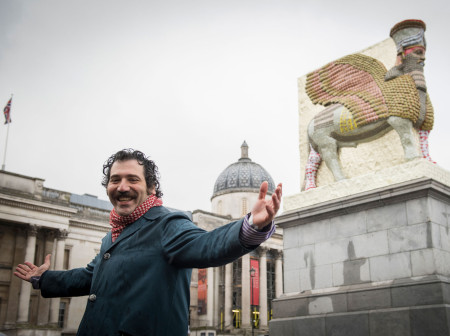
The Fourth Plinth, London: Northwestern artist Michael Rakowitz unveiled a 14-foot statue of the Lamassu, a winged Assyrian deity with the body of a bull and the head of a human, at the Fourth Plinth in London last March. Created from 9,000 steel cans of Iraqi date syrup, the piece is part of Rakowitz’s larger project The Invisible Enemy Should Not Exist, which uses ephemera to represent and commemorate lost Iraqi artifacts.
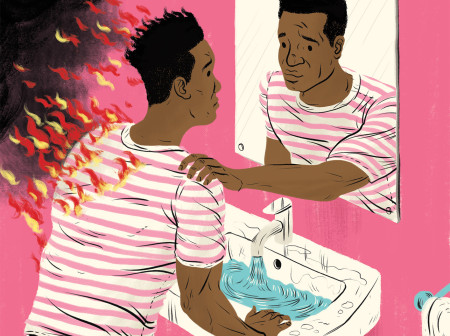
The typical Becoming a Man session includes a simple game: One young man tucks a small ball into his palm, while his partner has one minute to do whatever it takes to get it away from him. Often the young men start wrestling, trying to pry open their partner’s hand by force.
When Mary Deeley ’89 PhD, pastoral associate at Sheil Catholic Center, read a spring 2016 Daily Northwestern story about students battling food insecurity, she was shocked. “Why are there students who are hungry on this campus, where food is seemingly everywhere?” Deeley asks.